Email marketing for realtors means staying in touch with past clients, your sphere and new leads through regular, useful emails. Send a monthly local market update, listing alerts to active buyers, a review request after every closing, and a few personal touches a year. Only email people who agreed to hear from you.
ReviewUsToday sends review requests and promotional emails for local businesses, and real estate agents can point happy clients to Google, Zillow or Realtor.com. Every email carries the sender's address and a one-click unsubscribe link, which CAN-SPAM requires for marketing email.
What emails should a realtor send?
A realtor should send eight kinds of email, from a welcome note for new leads to a review request after closing. Market updates, listing alerts, just-sold notices, home anniversary notes and an occasional referral ask round it out. Each one goes to a different group at a different time, so one newsletter can't do every job.
| Who gets it | When | |
|---|---|---|
| Welcome | New leads | Within a day of signing up |
| Market update | Everyone on your list | Monthly |
| Listing alert | Active buyers in that price range | When a match lists |
| Just sold | Neighbors and your sphere | After closing |
| Closing thank-you | The client | Closing day |
| Review request | Every closed client | A few days after closing |
| Home anniversary | Past clients | Once a year |
| Referral ask | Happy past clients | Once or twice a year |
If I were starting from zero, I'd set up the review request and the monthly update first. One builds your reputation and the other keeps your name in the inbox between moves.
What is real estate email marketing?
Real estate email marketing is using email to turn leads into clients and past clients into repeat business and referrals. Buying or selling a home happens rarely, so the goal is staying remembered for years between transactions. Good emails do that by being useful, not by selling every time.
The gap between closings is the whole problem. Your client loved you in March. By the time they move again, they may remember you only as "the nice one with the Subaru". That's warm, but it's hard to search for.
Here's what NAR's latest buyer and seller research says about the people on your list:
| Finding | Figure |
|---|---|
| Buyers who purchased their home through an agent or broker | 88% |
| Sellers who used a real estate agent | 91% |
| Buyers who would use their agent again or recommend them | 91% |
Source: NAR 2025 Profile of Home Buyers and Sellers, covering transactions from July 2024 to June 2025 (NAR newsroom, REALTOR Magazine).
Willing to use you again isn't the same as remembering your name when it's time. Email is the cheapest way to close that gap.
How do you build an email list as a real estate agent?
Start with people who already know you: past clients, your sphere, and anyone who signed in at an open house. Then add a sign-up form on your website with a reason to join, like a monthly market report. Ask permission every time, and record where each contact came from.
- Gather past clients. Export them from your CRM, transaction files or phone contacts into one spreadsheet.
- Add your sphere. Friends, neighbors and past colleagues count, as long as they've agreed to hear from you.
- Use open house sign-ins. Add a checkbox that says they'd like market updates by email.
- Offer something worth an email address. A neighborhood price report beats "join my newsletter" every time.
- Tag everyone. Buyer, seller, past client, sphere and lead, so each group gets the right emails and nobody gets listing alerts for a house they just sold.
| Source | Tag it as | First email |
|---|---|---|
| Closed transactions | Past client | Review request, then market updates |
| Open house sign-in | Lead (with area and price) | Welcome plus similar listings |
| Website form | Lead | Welcome plus the report they asked for |
| Friends and family | Sphere | Monthly market update |
Don't buy a list. Strangers who never asked to hear from you will mark you as spam. Those complaints then follow your sending address around like a bad smell in an open house. Our email marketing tips cover list hygiene in more detail.
What goes in a real estate market update email?
A good market update gives a few local numbers and explains what they mean for the reader. Include recent sales near them, the median price, how long homes are taking to sell, and one or two listings worth seeing. Finish with one link, like a free price estimate or a reply to you.
| Part | Sample |
|---|---|
| Headline number | "Oak Hill homes sold in a median 18 days in September" |
| Recent sales | 3 to 5 nearby sales, with price and days on market |
| What it means | One sentence for buyers and one for sellers |
| Featured listing | One home, one photo, one link |
| One next step | "Reply for a free price estimate on your home" |
Pull the numbers from your MLS and say where they came from. I'd keep the whole email under 300 words, because readers are deciding whether to keep opening your emails, not studying for an exam. Nobody has ever reached the end of a market update and wished it had a fourth chart.
How often should a realtor send marketing emails?
Once a month is a sensible baseline for your whole list, usually a local market update. Active buyers can get listing alerts as often as matches appear. Past clients need fewer emails, maybe monthly plus a home anniversary note. If unsubscribes climb after a send, slow down.
| Group | How often | What they get |
|---|---|---|
| Active buyers | As matches list | Listing alerts, showing reminders |
| Active sellers | Weekly during the listing | Showing feedback and activity updates |
| New leads | 2 to 3 emails in the first two weeks | Welcome, local guide, a check-in |
| Past clients | Monthly, plus their anniversary | Market update, equity note, referral ask |
| Sphere | Monthly | Market update, just sold, local events |
The honest answer is that consistency beats frequency. A monthly email that actually goes out every month beats a weekly plan that dies in week three, quietly, like a sourdough starter.
How do you ask past clients for referrals by email?
Ask after you've already delivered something, like a smooth closing or a home anniversary note, and make it easy to say yes. Keep it to one short email once or twice a year. Name the kind of person you can help, because "send me your friends" is much harder to act on than a specific ask.
Here's a version you can adapt:
"Hi Jordan, it's been a year since you got the keys to Elm Street, and I hope it still feels like home. If a friend or neighbor mentions buying or selling, I'd be glad to help them too. Just reply with their name, or pass on my number. Thanks, Alex"
| Good moment to ask | Why it works |
|---|---|
| Home anniversary | You're already sending a friendly note |
| After a happy client reviews you | They've just said nice things in public |
| Spring, before listing season | Friends are starting to talk about moving |
If you're thinking of offering anything for a referral, check your state's real estate rules and your brokerage first. A handwritten thank-you card costs less and has never once started a compliance meeting.
How do real estate agents write emails people open?
Use a specific subject line, send it from your own name, and lead with something local. A subject like "What sold on Maple Street in September" gets opened because it's about the reader's street. "Your monthly real estate newsletter" sounds like homework, and it gets treated like homework.
| Skip this subject line | Try this instead |
|---|---|
| "Monthly newsletter, October edition" | "3 homes sold near Lincoln Park this month" |
| "Exciting real estate news!!!" | "What your home might be worth now" |
| "Just listed" | "Just listed: 3 bed with a yard, $425K, Oak Hill" |
| "Checking in" | "Happy 2-year home anniversary, Jordan" |
Inside the email, keep one main link and one clear action. A market update needs a few local numbers and a sentence on what they mean, not a 1,500-word essay on mortgage rates. Write it the way you'd explain it at a kitchen table, with the coffee going cold.
Make every email readable on a phone. People check email in odd moments, like waiting at a school pickup line or pretending to listen on a conference call.
You don't need a fancy template, either. A plain email with your photo and signature reads like a note from a person, which is exactly what you are (most days, before coffee).
What rules apply to real estate email marketing?
In the US, marketing emails fall under the CAN-SPAM Act. Your emails need honest sender details and subject lines, your physical postal address, and a clear way to opt out. You must honor an opt-out within 10 business days. The FTC says each violating email can cost up to $53,088.
| CAN-SPAM requirement | What it means for an agent |
|---|---|
| No false or misleading header information | Send from your real name, brokerage or business |
| No deceptive subject lines | The subject matches what's inside |
| Tell recipients where you're located | Include a valid physical postal address |
| Tell recipients how to opt out | Put a clear unsubscribe link in every email |
| Honor opt-out requests promptly | Within 10 business days, and never email them again |
| Monitor others acting for you | You're still responsible if a vendor sends it |
Source: FTC CAN-SPAM Act compliance guide for business. This is general information, not legal advice. Your brokerage and state may have extra advertising rules.
The good news is that most email tools handle the footer for you. ReviewUsToday adds your business name, address and a one-click unsubscribe link to every email, and nobody who unsubscribes is emailed again.
Should realtors ask for reviews by email?
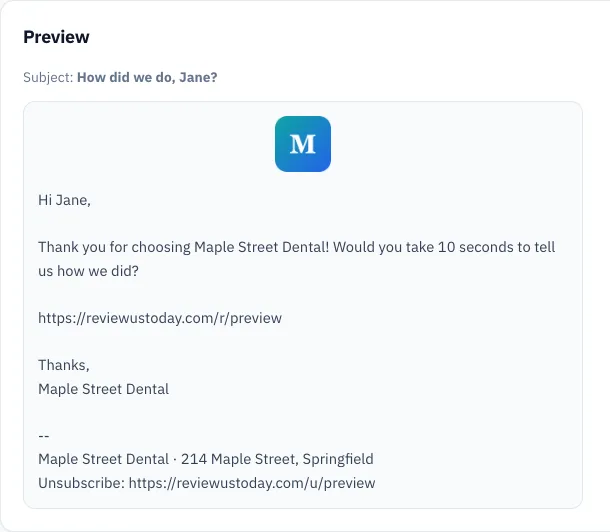
Yes. A review request a few days after closing is one of the most useful emails an agent sends, since new clients check reviews first. Ask every client the same way, link straight to the review site, and send a reminder if they don't respond. Never offer a gift card or discount in exchange.
Your clients are used to it. In BrightLocal's 2026 Local Consumer Review Survey, 78% of consumers were asked to write a review in the last 12 months. Consumers also use an average of six review sites, so it helps to let each client choose.
For agents, that usually means Google, Zillow or Realtor.com. Pick the two or three that matter most in your market, rather than offering a menu longer than the closing paperwork.
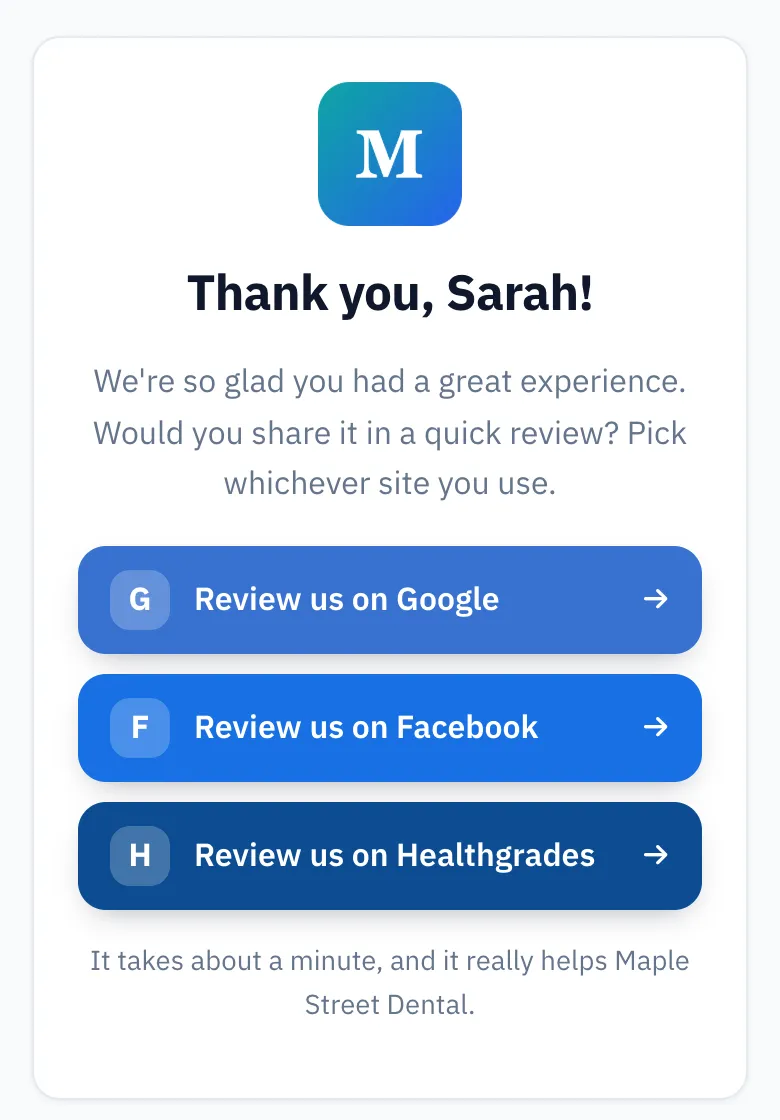
Keep incentives out of it. Google's policy bars businesses from offering incentives "such as payment, discounts, free goods and/or services" for reviews. A closing gift is fine when it isn't tied to a review. Our review request email templates have wording you can adapt, and the full list of supported sites is on our review sites page.
To send clients straight to the right place on Google, use your direct Google review link instead of asking them to search. For timing and wording beyond real estate, see our guide on how to ask for reviews.
What do email results look like in practice?
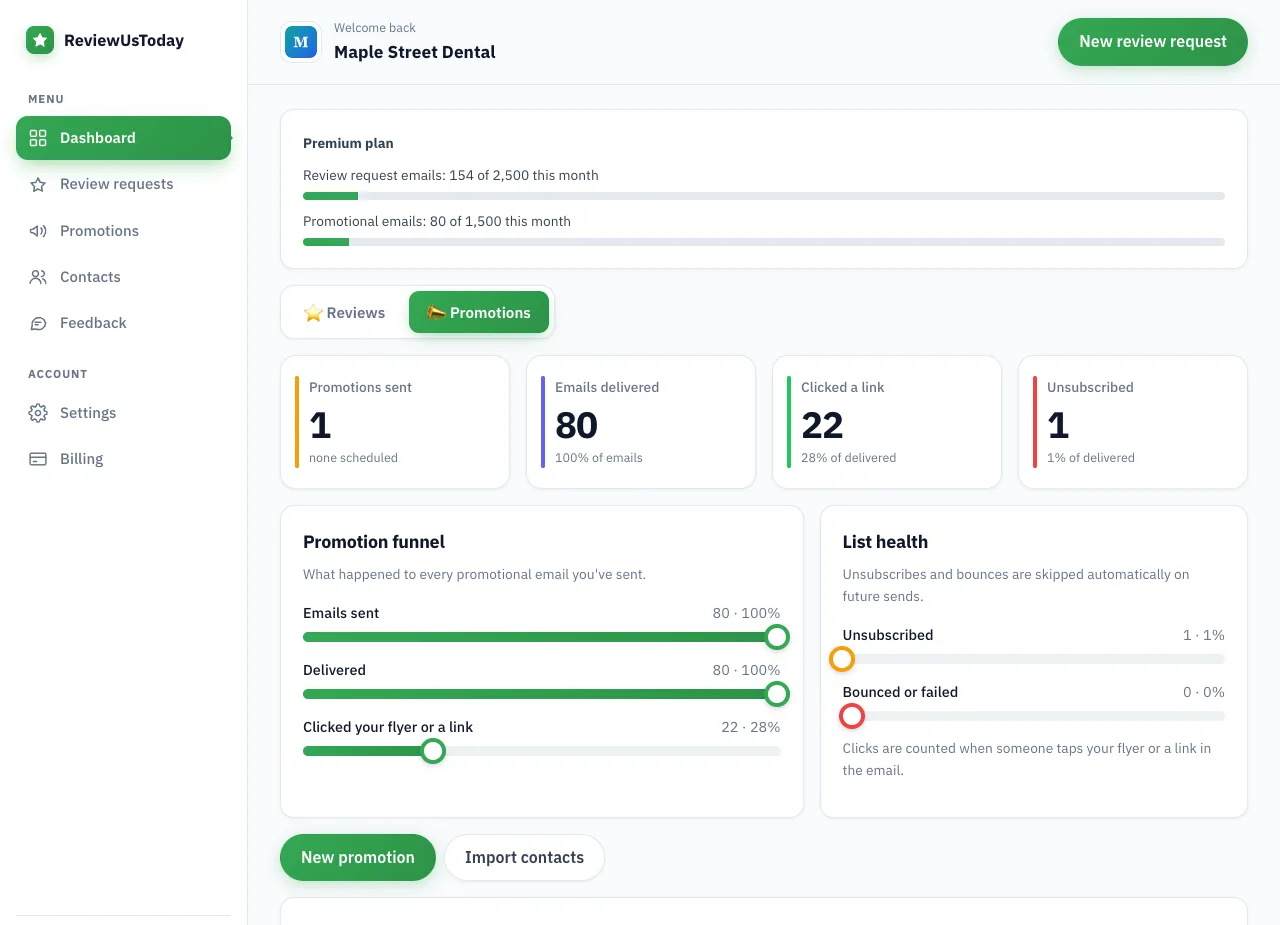
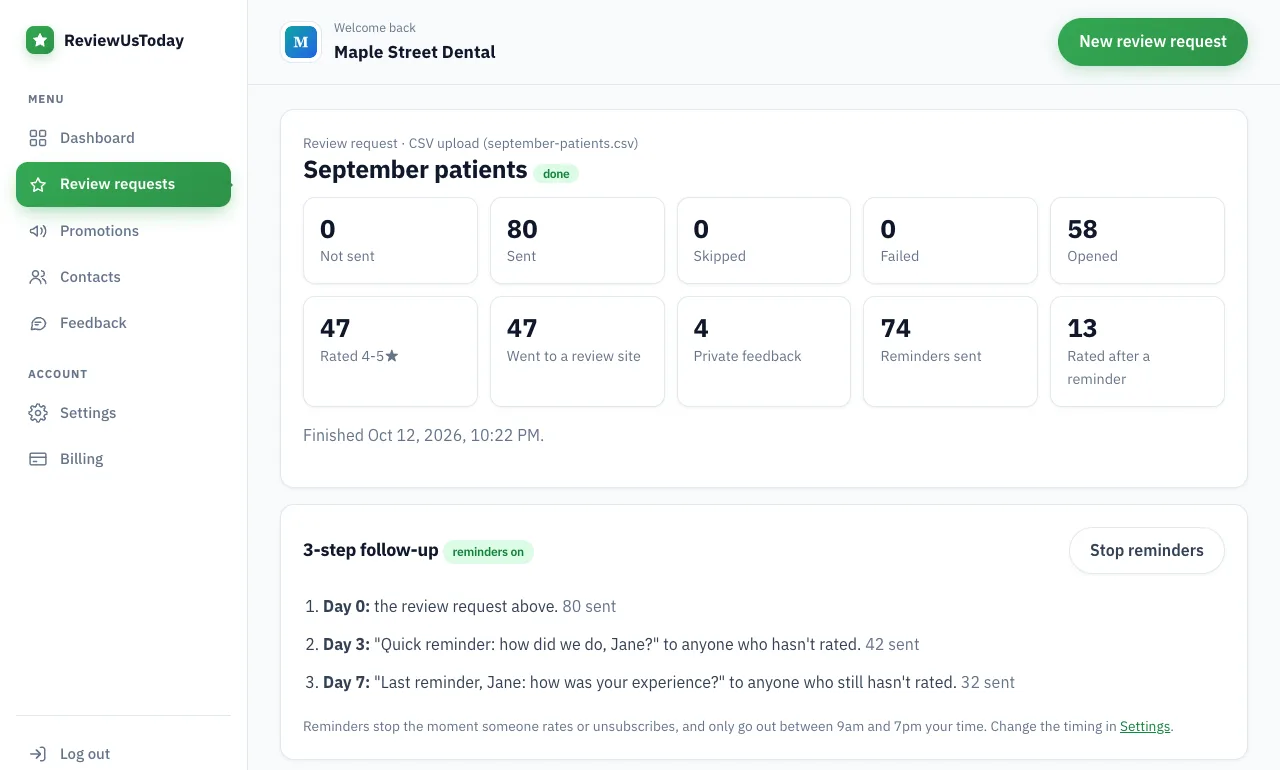
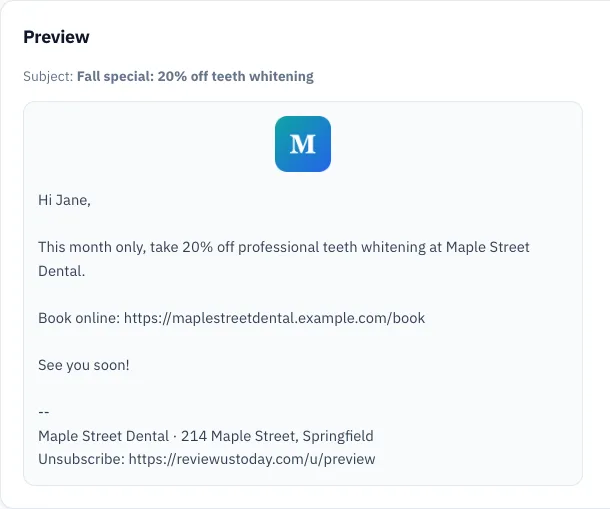
Here's a sample from ReviewUsToday's demo account, Maple Street Dental, run with 80 sample customers. It's a dental office rather than a realtor, and it's sample data, not a real customer's results. It still shows what you'd see after a send.
| Demo email | Result |
|---|---|
| Review requests sent | 80 |
| Rated | 51, average 4.7 |
| Went on to a review site | 47 |
| Ratings that came in after a reminder | 13 |
| Promotion sent to the same 80 | 22 clicked, 1 unsubscribed |
The number I'd watch is the unsubscribe count after each promotion. One is normal. A sudden jump means you've been sending too often, or sending things your list doesn't care about.
Your own numbers will look different, especially with a smaller list. That's fine, because the trend from one send to the next tells you more than any single result.
Where ReviewUsToday fits
ReviewUsToday emails every closed client a one-tap review request for Google, Zillow, Realtor.com or other sites you choose, with two automatic reminders. Pro and Premium plans also send promotional emails and flyers to your list or a tag, now or on a schedule. It isn't a real estate CRM, and it doesn't send listing alerts, drip sequences or texts. See how email marketing for local businesses works.
Frequently asked questions
What is the best email marketing for realtors?
The best setup is the one you'll keep using: a monthly market update to your whole list, listing alerts for active buyers, and a review request after every closing. Pick a tool that handles unsubscribes and your address footer for you.
How often should a real estate agent email past clients?
About once a month, usually with a local market update. Add a home anniversary note once a year, and slow down if unsubscribes rise.
Is it legal to email people from an open house sign-in sheet?
It's safest to email only people who agreed to hear from you, so add a clear checkbox for email updates. Every marketing email also needs your postal address and an unsubscribe link under CAN-SPAM.
What should a real estate newsletter include?
A few local numbers, like recent sales and prices, plus a sentence on what they mean. Add one or two listings or local events and one clear link.
Should realtors ask clients for Zillow or Google reviews?
Ask for both if they matter in your market, and let each client choose. Ask every client the same way and never offer anything in exchange.
Sources
- NAR: First-time home buyer share falls to historic low (2025 Profile of Home Buyers and Sellers)
- REALTOR Magazine: NAR 2025 Profile of Home Buyers and Sellers reveals market extremes
- FTC: CAN-SPAM Act compliance guide for business
- BrightLocal: Local Consumer Review Survey 2026
- Google: Maps user-generated content policy
Keep reading
Email marketing tips for local businesses: 12 that bring customers back
Email marketing tips for local businesses: 12 tips, email ideas for every month, subject lines, how often to send, and the Google and CAN-SPAM rules.
Review request template: 7 emails you can copy and send today
Copy-paste review request template emails with subject lines: after a service, after a purchase, reminders, a short version, an owner note and a clinic version.
How to get your Google review link
Google review link in 3 steps, straight from Google's help pages. Skip the generators, avoid the profile-link mistake, and see where the link earns reviews.