Email marketing for lawyers means sending useful, permission-based emails to clients and contacts: a newsletter, legal updates, check-ins, event invites and review requests. Email only people who agreed to hear from you, follow CAN-SPAM and your state bar's advertising rules, and never mention a client's matter.
ReviewUsToday sends promotional emails and review requests for local businesses, including law firms. Every message carries the unsubscribe link, postal address and List-Unsubscribe headers automatically. Here's what's worth sending, and which rules apply before you hit send.
What emails should a law firm send?
Most firms only need a handful of email types. A newsletter keeps you in mind between matters. A review request goes out when a matter closes. Check-ins and legal updates remind past clients that you still exist when their next problem shows up.
| Who gets it | When | What it's for | |
|---|---|---|---|
| Monthly or quarterly newsletter | Clients and contacts who opted in | Once a month or once a quarter | Staying top of mind for referrals and repeat work |
| Legal update | Clients in the affected practice area | When a law or deadline changes | Showing you're watching out for them |
| Review request | Every client whose matter just closed | Right after the matter closes | Honest reviews on Google and legal directories |
| Check-in | Past clients, e.g. estate planning or business clients | Yearly, or after a life or business change | Prompting a review of documents or contracts |
| Event or webinar invite | Contacts in the relevant segment | Two to three weeks before | Meeting people before they need you |
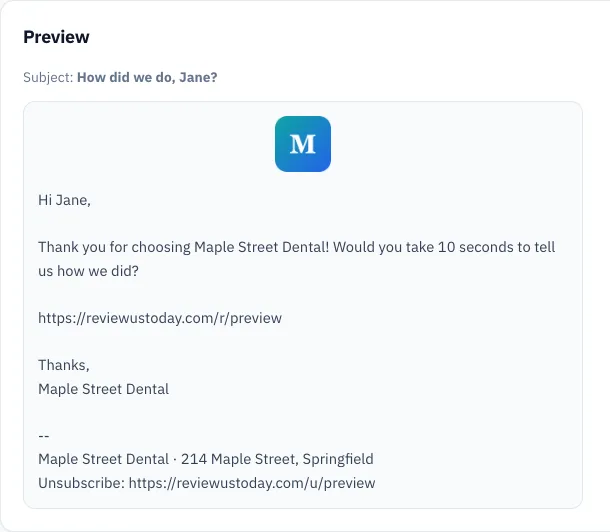
I'd start with two: the review request and a quarterly newsletter. Five email types on day one is how a marketing plan ends up in the same folder as the 2019 office holiday party photos.
How do you do email marketing for a law firm?
Start with a list of clients and contacts who agreed to hear from you. Split it by practice area and pick one or two email types. Put them on a schedule you can keep. Then watch clicks and unsubscribes after each send and adjust.
- Build a clean list. Export clients from your practice management software or contacts. Only include people who agreed to receive email from the firm.
- Segment by practice area. A probate update means nothing to a client who hired you for a lease dispute.
- Choose your emails. Pick from the table above. Fewer, better emails beat a busy calendar.
- Write like a person. Short paragraphs, plain English, one clear next step. "Pursuant to" can stay in the engagement letter.
- Send on a schedule. Same week each month or quarter, so it becomes a habit.
- Measure and prune. Check clicks and unsubscribes after each send, and stop sending what nobody opens.
Our email marketing tips cover subject lines and timing in more depth. Rather not run a separate newsletter tool? ReviewUsToday's email marketing sends promotions to your client list or a tag, now or on a schedule.
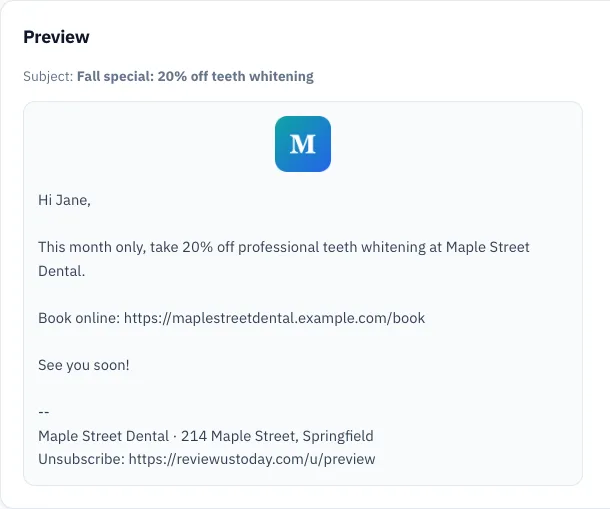
What rules apply to law firm email marketing?
Two sets of rules apply. The federal CAN-SPAM Act covers every commercial email, from any business. Your state bar's advertising rules sit on top, and they vary by state. Confidentiality applies to everything you write, so no email should ever hint at a client's matter.
The FTC's CAN-SPAM compliance guide says the law "covers all commercial messages," not just bulk email. Here's what it requires, in firm terms:
| CAN-SPAM requirement | What it means for a law firm |
|---|---|
| Accurate header information | Send from the firm's real name and address |
| No deceptive subject lines | The subject line matches what's inside |
| Identify the message as an ad | Make it clear when an email is promotional |
| Include a valid postal address | Put the office address in the footer |
| Explain how to opt out | A clear unsubscribe link in every marketing email |
| Honor opt-outs promptly | Within 10 business days, per the FTC |
| Monitor others acting for you | You're responsible even if a vendor sends it |
Source: FTC CAN-SPAM Act compliance guide, checked 12 October 2026. Each violating email can draw a penalty of up to $53,088.
Bar rules are where states differ. Florida is a clear example. The Florida Bar's lawyer advertising FAQ says: "For email advertisements, the subject line must begin with the word "advertisement."" The same FAQ says some ads don't have to be filed for review. That covers ads sent only to current or past clients, and to people who asked for information.
Skipping the filing isn't a pass on the rest, though. The Bar's email checklist also flags anything "misleading or deceptive" and any predictions of success. Check your own state bar's rules before your first send. This is general information, not legal advice.
What should a law firm email say (and never say)?
Share something useful to the reader: a deadline, a law change, a plain-English explainer or an invite. Never mention a client's name, matter, outcome or fee. Never promise results. If a sentence would look odd read aloud to your bar's ethics counsel, cut it.
| Put this in | Leave this out |
|---|---|
| A practical tip or deadline reminder | Any client's name, case or outcome |
| A plain-English summary of a law change | "We'll win your case" or any guarantee |
| One clear next step, like booking a call | Five competing links |
| The firm's name, address and unsubscribe link | Attachments clients didn't ask for |
Case results are tempting, but they're the riskiest thing to email, between confidentiality and bar rules on predicting success. A "here's what changed in the state's new filing deadlines" email is less thrilling and much safer. Your clients will forgive you for being useful.
How often should a law firm send marketing emails?
Once a month is a sensible ceiling for most small firms, and once a quarter works fine. Send legal updates only when something changes, and review requests only when a matter closes. Watch your unsubscribe numbers: if they climb after a send, slow down.
Frequency matters less than consistency. A quarterly newsletter that really goes out every quarter beats a weekly one that dies in week three. If I ran a small firm, I'd block one afternoon a quarter for the newsletter and protect it like a court date.
Practice areas have their own rhythms, too. Estate planning clients might hear from you once a year. Family and criminal clients may prefer not to hear from you at all, and that's worth respecting.
Can email help a law firm get more reviews?
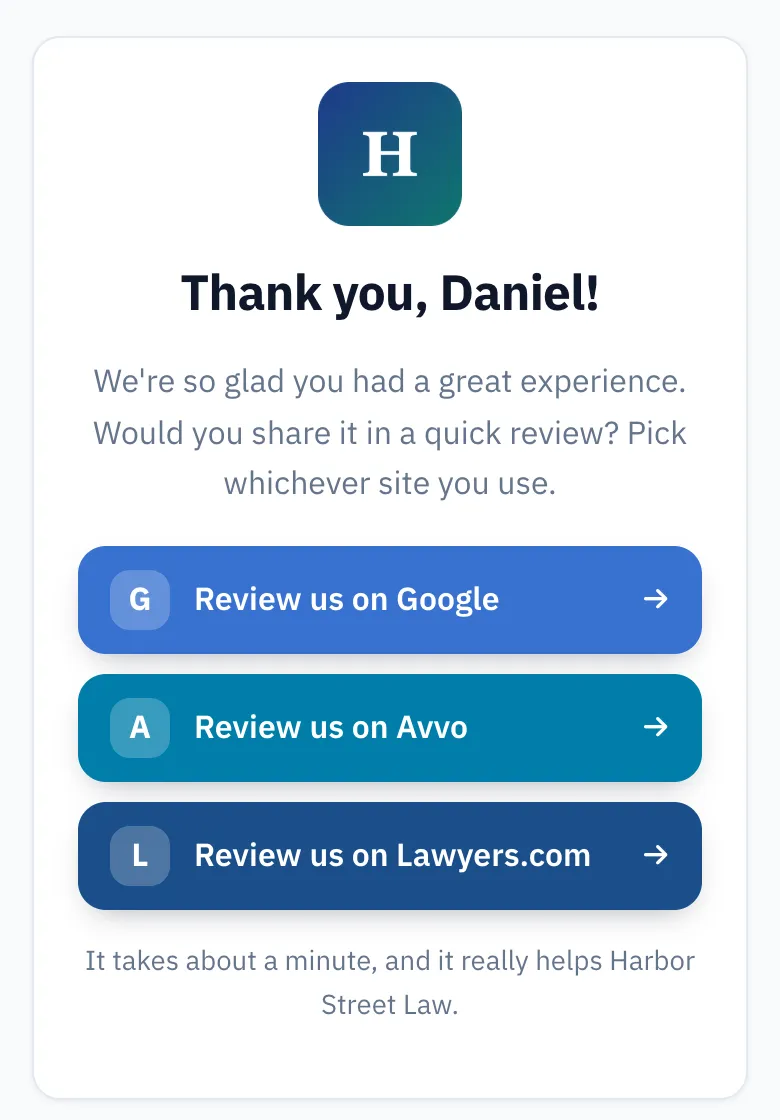
Yes. Email is the simplest way to ask every client for a review the moment a matter closes, with a one-tap link to your review page. In BrightLocal's Local Consumer Review Survey 2026, 78% of consumers were asked to write a review in the last 12 months.
The same survey found 28% will "always" write one if asked, up from 16% in 2025. So asking works. The trick is asking everyone the same way, with no incentives and no hand-picking of happy clients.
Our guide to reputation management for lawyers covers what bar rules and Google allow when asking for reviews. For ready-to-adapt wording, see our review request email templates.
What does a promotional email send look like in practice?
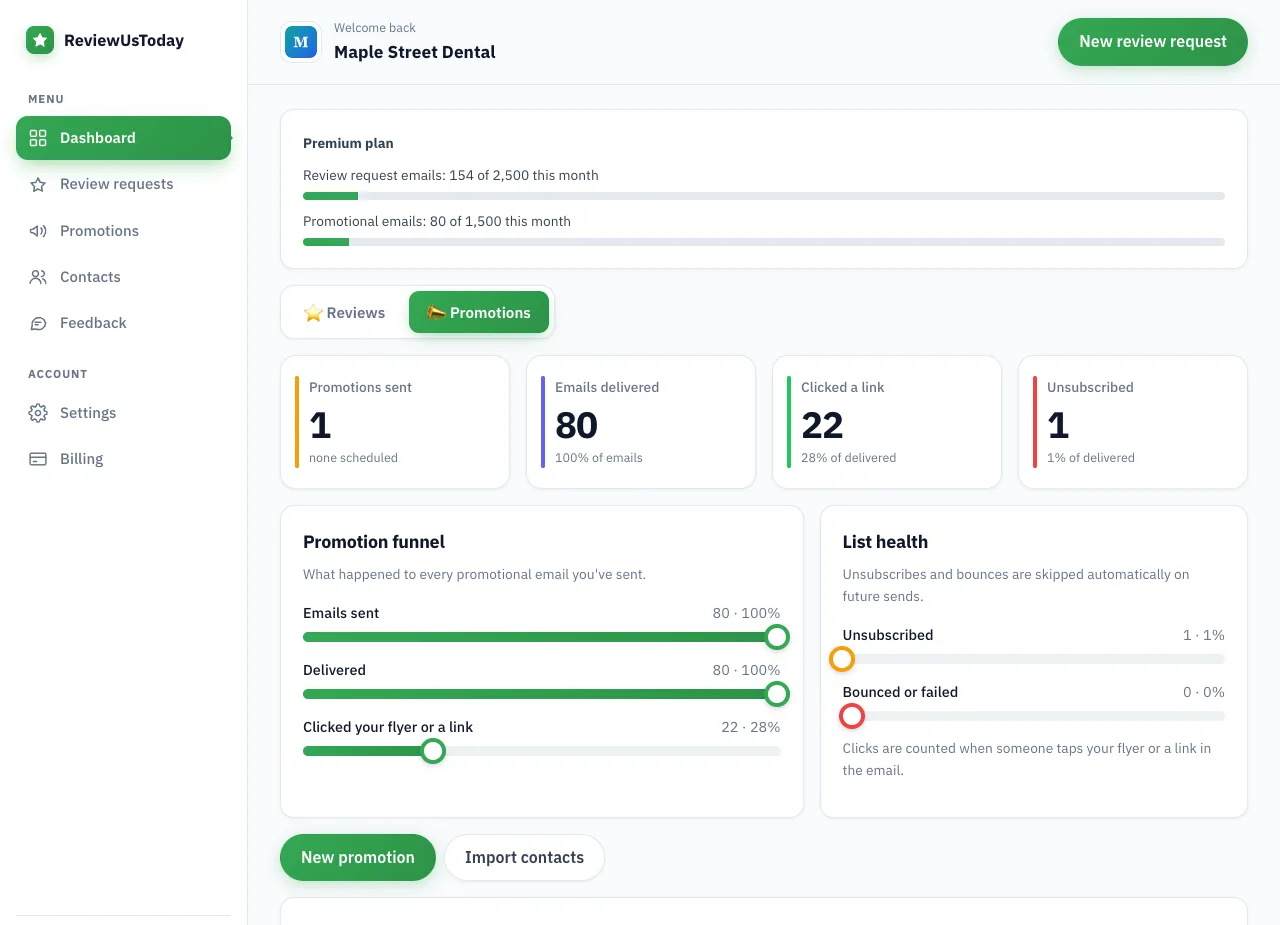
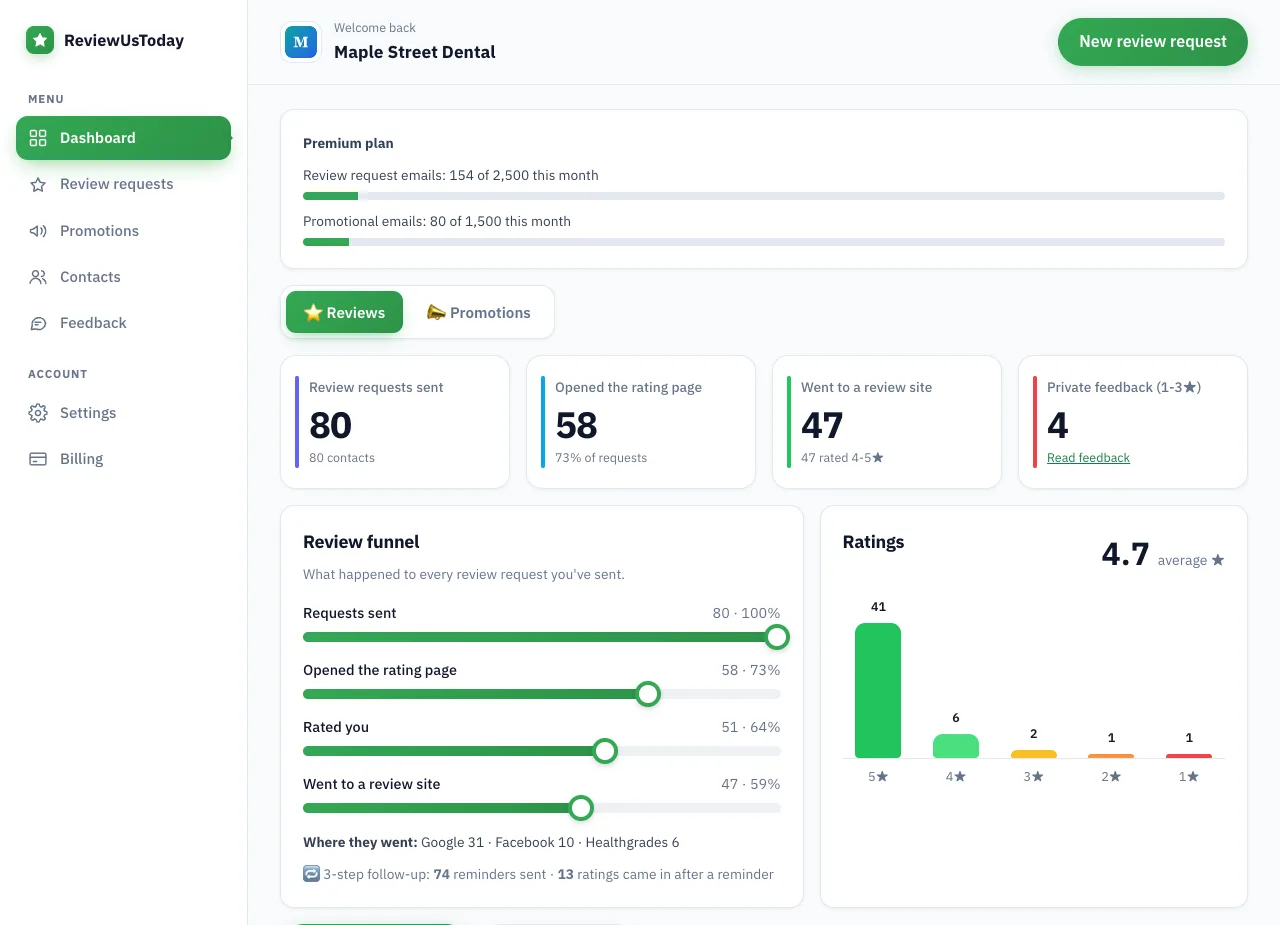
We sent a promotion through ReviewUsToday from a demo account, "Maple Street Dental", to 80 sample customers. It's a demo with sample data, not a real business's results, but it shows what you'd track after any send, including a firm newsletter.
| What the dashboard showed | Demo result |
|---|---|
| Promotional emails sent | 80 |
| Clicked a link or flyer | 22 |
| Unsubscribed | 1 |
The unsubscribe is the number I'd watch first. One person leaving isn't a crisis. Five leaving after every send means the emails are too frequent or not useful enough.
Where ReviewUsToday fits
ReviewUsToday emails review requests and promotions to the clients you upload by CSV, with your logo, address and an unsubscribe link on every message. It doesn't send texts, write your newsletter content or check it against your state bar's rules, so that review stays with you. See how email marketing for local businesses works, with plans from $50 a month and no contract.
Frequently asked questions
Is email marketing effective for law firms?
It can be, because it reaches past clients and contacts who already know the firm. It works best when emails are useful, sent on a steady schedule, and only go to people who agreed to receive them.
Do lawyers have to put "advertisement" in marketing emails?
It depends on your state. In Florida, the Bar's advertising FAQ says the subject line of an email advertisement must begin with the word "advertisement." Check your own state bar's rules before sending.
Does CAN-SPAM apply to law firm newsletters?
CAN-SPAM covers commercial email, and the FTC says it applies to all commercial messages, not just bulk email. A marketing newsletter needs accurate sender details, a postal address and a working opt-out that you honor within 10 business days.
Can a law firm email past clients?
Yes, if they agreed to hear from you. Never mention their matter in a marketing email, and remove anyone who unsubscribes.
What should a law firm newsletter include?
Practical tips, deadline reminders, plain-English summaries of law changes and event invites. Leave out client names, case results and any promise of an outcome.
Sources
Keep reading
Reputation management for lawyers: get more reviews without an ethics problem
Reputation management for lawyers: which review sites matter, what bar ethics rules allow, and how to reply to reviews without breaking confidentiality.
Email marketing tips for local businesses: 12 that bring customers back
Email marketing tips for local businesses: 12 tips, email ideas for every month, subject lines, how often to send, and the Google and CAN-SPAM rules.
Review request template: 7 emails you can copy and send today
Copy-paste review request template emails with subject lines: after a service, after a purchase, reminders, a short version, an owner note and a clinic version.