Reputation management for lawyers means earning a steady stream of honest client reviews on Google and legal directories like Avvo and Martindale-Hubbell. It also means replying without revealing anything confidential. Ask every client the same way when a matter closes. Never pay for reviews, never ask only happy clients, and keep every reply free of case details.
ReviewUsToday sends review requests for firms to Google, Avvo, Lawyers.com, Martindale-Hubbell and 27 other review sites, and its flow follows the rules below. Here's what those rules allow, which sites matter, and a process a small firm can run in an afternoon, no billable hours required.
Which review sites matter most for lawyers?
Google matters most for most firms, because that's where clients start. In FindLaw's 2024 U.S. Consumer Legal Needs Survey, 97% of respondents who searched for online information about the attorney they contacted used search engines. Legal directories come next, and Yelp is a special case.
| Review site | Why it matters for a law firm | Can you ask clients for reviews there? |
|---|---|---|
| Reviews show beside your firm in search and on Maps, where most clients start | Yes, if you ask without incentives and don't single out happy clients (Google's policy) | |
| Avvo | A lawyer-specific directory with ratings and client reviews; "avvo" gets about 14,800 US searches a month (Semrush, October 2026) | Check Avvo's current guidelines, and your state bar's rules |
| Martindale-Hubbell | Lawyer directory with peer and client review ratings | Martindale says each firm is "wholly responsible" for ethics compliance when using its ratings |
| Lawyers.com | Consumer-facing lawyer directory with client reviews | Same caution: follow your state bar's rules |
| Yelp | Some clients check it, especially for consumer law | No. Yelp's guidelines say "Businesses should never ask customers to write reviews." |
I'd pick two or three, not seven. A client who has to choose between five buttons will often choose the sixth option: closing the tab. See every site we support on our review sites page.
What is online reputation management for lawyers?
Online reputation management for lawyers shapes what a prospective client finds when they search your name: reviews, star rating, replies and directory profiles. For a small firm, most of it comes down to two habits: asking every client for a review, and replying well when one goes wrong.
It matters because referrals no longer do the whole job. Here's how clients found and checked their attorney in FindLaw's 2024 U.S. Consumer Legal Needs Survey, a poll of 2,000 U.S. adults with a recent legal need:
| What clients did | Share |
|---|---|
| Used search engines, among those who looked up their attorney online | 97% |
| Relied on online reviews, among those who contacted an attorney after learning about them online | 82% |
| Used referrals, among those who learned about the attorney they contacted | 48% |
| Called reviews their primary source, among those who used reviews | Nearly 40% |
Sources: FindLaw survey summary and key takeaways.
Even a referred client usually Googles you before calling. Your best client's glowing recommendation can still lose to a profile with three reviews from 2019, which is a cross-examination nobody prepared for.
Can lawyers ask clients for reviews?
Yes, in general. Bar ethics rules typically let you ask current and former clients for reviews. Just don't encourage anything false or misleading, and don't pay for them.
The details are set by your state bar, so check your state's rules and ethics opinions before you start. This is general information, not legal advice.
Texas is a clear example. Texas Professional Ethics Committee Opinion 685 says the rules:
"do not prohibit a lawyer from encouraging current and former clients to leave positive reviews or ratings online, provided that the lawyer does not encourage the clients to make statements that are false, misleading, or unfounded."
Incentives are where firms trip. New York's bar allowed a small credit in Opinion 1052, as long as it wasn't tied to what the client wrote. Google's policy is stricter: it bars offering incentives "such as payment, discounts, free goods and/or services" in exchange for a review. So even where your bar allows a credit, Google doesn't, and Google is where the reviews live.
The FTC's rule on fake reviews also prohibits incentives "conditioned on the writing of consumer reviews expressing a particular sentiment." Here's how the common situations line up:
| What you do | Bar ethics (Texas example) | Google's policy |
|---|---|---|
| Ask every client for an honest review | Allowed (Opinion 685) | Allowed: you may "solicit or encourage" genuine reviews "without offering incentives" |
| Ask only clients you expect to be happy | Check your state's rules | Not allowed ("selectively solicit") |
| Offer a discount or credit for a review | Varies by state (New York allowed a small credit in Opinion 1052) | Not allowed |
| Suggest what the client should write | Not if it's "false, misleading, or unfounded" (Opinion 685) | Reviews must reflect a genuine experience |
The safest version is boring, which in ethics is a compliment: ask everyone the same way, offer nothing, and let each client say whatever they honestly think.
Is it review gating to ask only happy clients?
Yes. Asking only the clients you expect to be happy is review gating. Google's policy lists "selectively solicit positive reviews from customers" among the things businesses may not do. Screening clients with a survey first, then sending only the satisfied ones to Google, counts too.
The FTC's guidance on its review rule says the rule itself doesn't specifically ban this, then adds: "But this practice could violate the FTC Act." That's the regulatory version of "technically allowed, please don't."
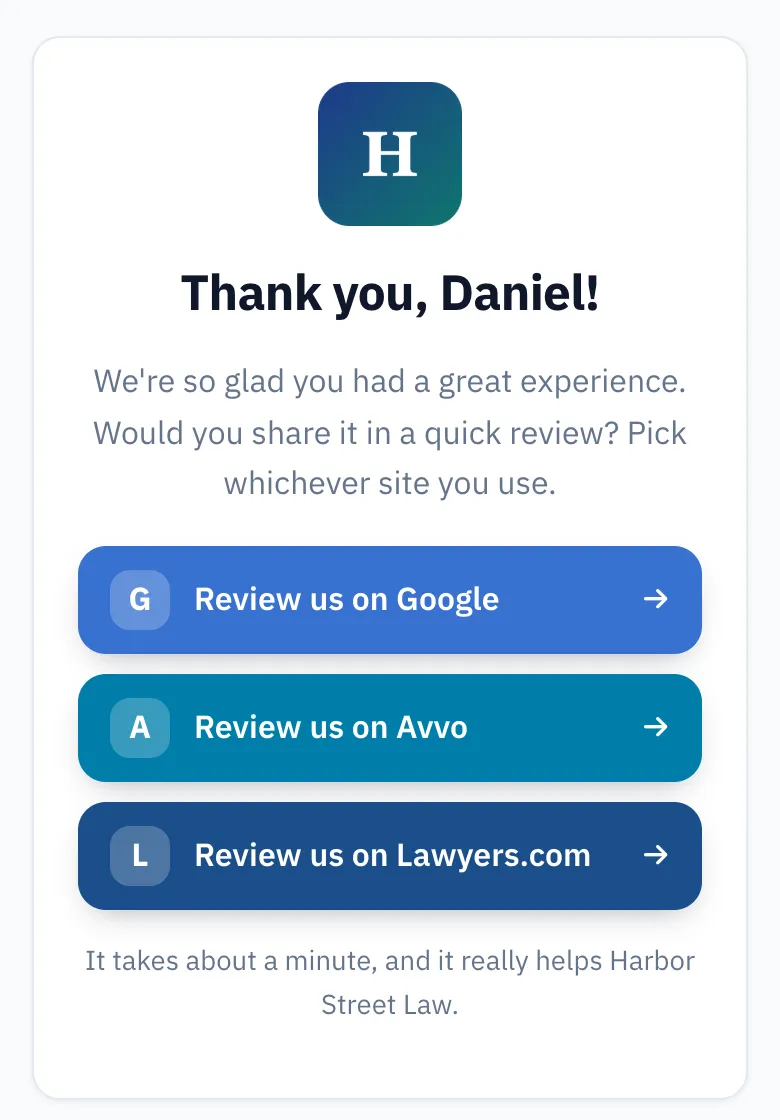
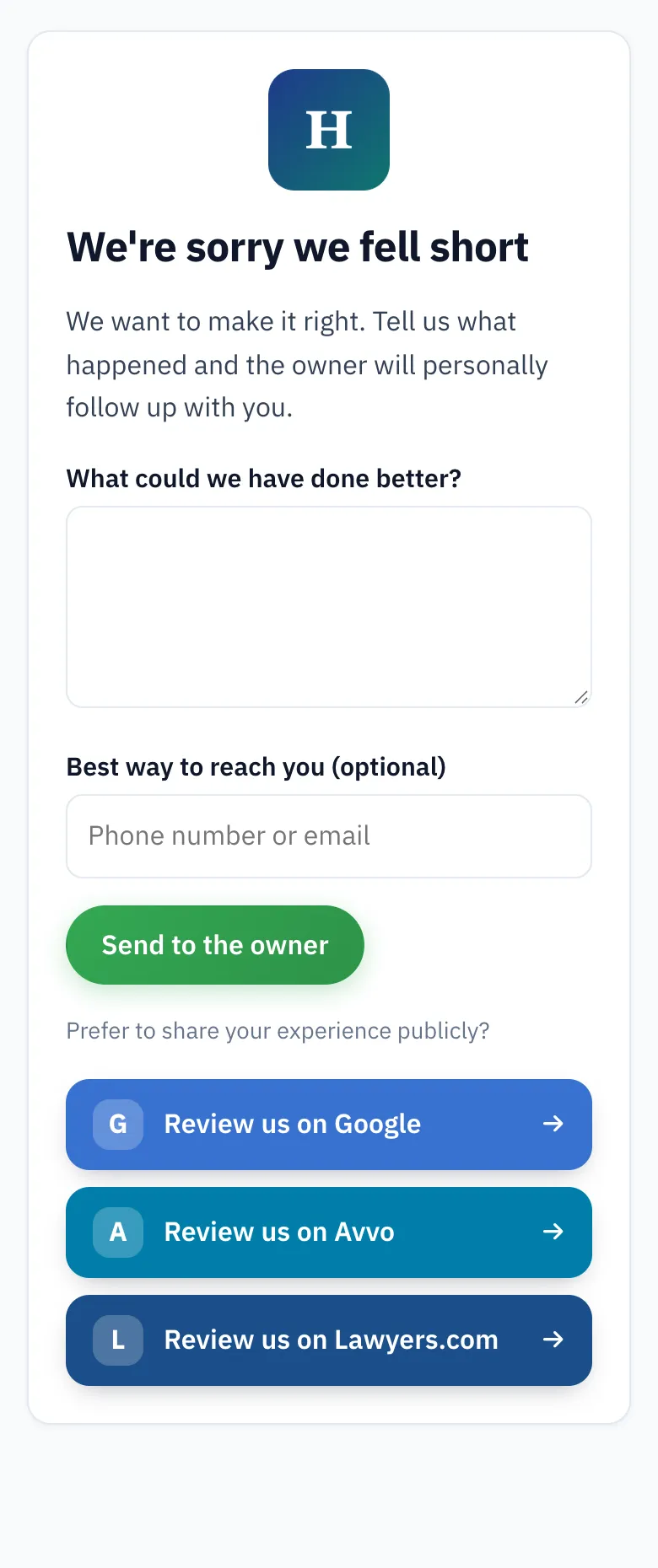
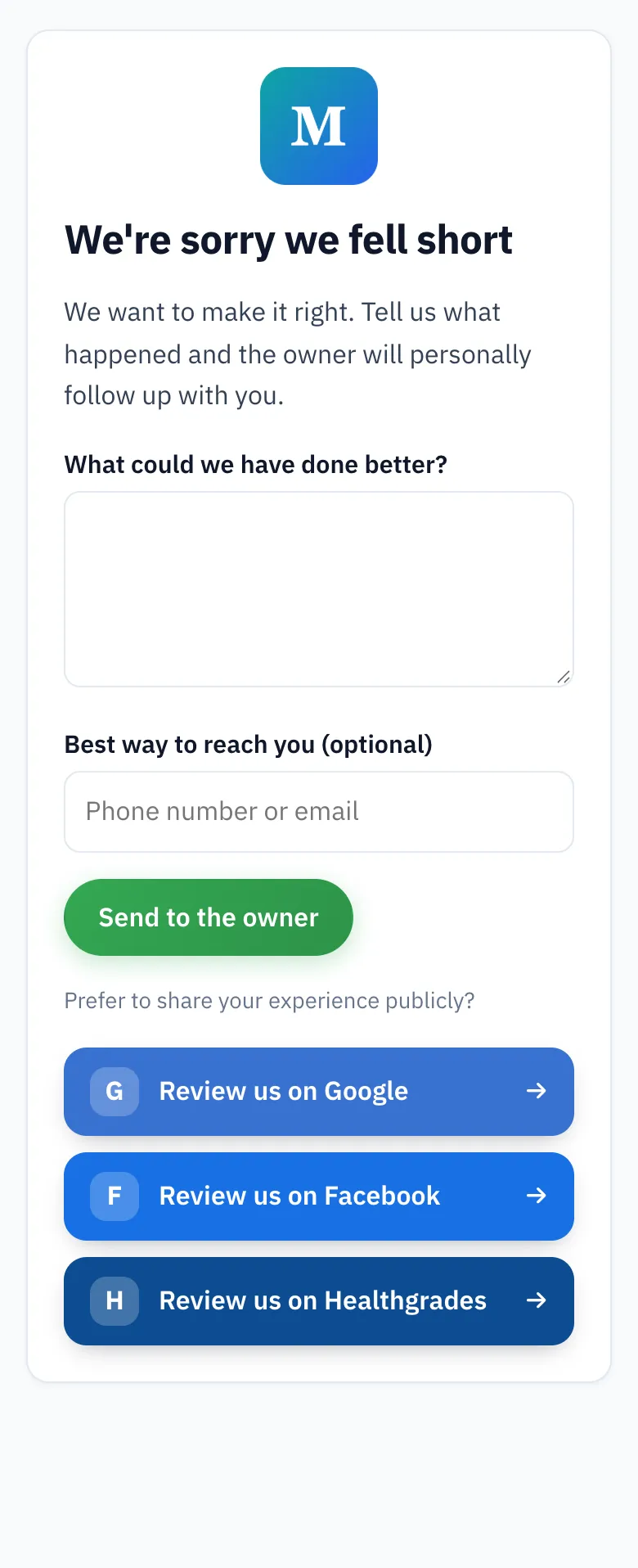
A compliant flow still lets you hear about problems first. In ReviewUsToday, a client who taps 1 to 3 stars gets a private form to tell you what went wrong.
The same page still shows every public review button. Nobody is blocked from posting. Our guide to review gating covers the rules in more depth.
How do you get more reviews for a law firm?
Ask every client, right after the matter closes, with a direct link to your review page. Then send one or two reminders to anyone who hasn't responded. Most clients who don't review were simply never asked, or meant to and forgot between the closing letter and the final invoice.
- Pick your moment. Ask when the work is done: the case closes, the estate plan is signed, the deal records. Never mid-matter, when a client may feel a request is tied to how their case goes.
- Ask everyone the same way. One template, every client, including the ones whose matter didn't end the way they hoped.
- Make it one tap. A direct link to your Google review page beats "find us on Google" every time.
- Follow up twice, then stop. A reminder a few days later and a last one a week out. After that, silence is an answer.
- Keep it discreet. In family, criminal and immigration matters, some clients won't want a public review at all. A neutral email from the firm, with no case details, respects that.
| When | What goes out | Who gets it |
|---|---|---|
| Day 0 (matter closes) | The review request | Every client |
| Day 3 | A short reminder | Only clients who haven't rated |
| Day 7 | A last reminder | Only clients who still haven't rated |
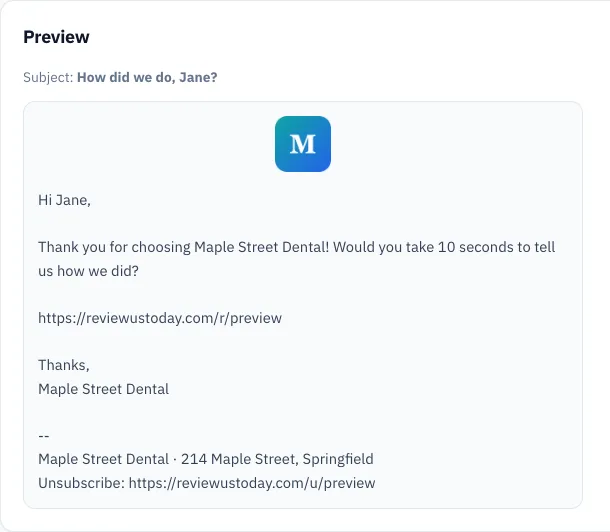
Want the wording? Our review request email templates are easy to adapt for a firm, and the guide to asking for reviews covers the basics. If you'd rather not send them one by one, ReviewUsToday's review management emails every client a one-tap request and handles the reminders.
How should a lawyer respond to a negative review?
Briefly, politely, and without a single confidential detail. Ethics opinions are consistent here: a client's bad review does not give you permission to tell your side of the case. Thank them, say you can't discuss client matters publicly, and invite them to contact the office.
Texas Ethics Opinion 662 puts it plainly: a lawyer "may not publish a response to a former client's negative review on the internet if the response reveals any confidential information," but "may post a proportional and restrained response that does not reveal any confidential information." Other states reach similar conclusions, so check yours.
| In a public reply, do | In a public reply, don't |
|---|---|
| Thank the reviewer and stay polite | Mention case facts, the outcome, fees or anything learned in the representation |
| Say you can't discuss client matters publicly | Argue point by point or correct their version of events |
| Invite them to call the office | Threaten legal action over the review |
A good reply has three parts:
- Thank the reviewer for the feedback.
- Say your professional obligations prevent you from discussing client matters publicly.
- Invite them to call the office.
Put together, it reads like this:
"Thank you for your feedback. Our professional obligations prevent us from discussing any client matter in a public forum. We take every concern seriously, and we'd welcome a call to the office to talk it through."
If I could tape one rule to every firm's monitor, it would be this: never argue the case in the comments. Future clients aren't grading who was right; they're grading whether you stay calm under pressure, which is, conveniently, the job. More examples are in our guide on how to respond to negative reviews.
What does a law firm's first round of review requests look like?
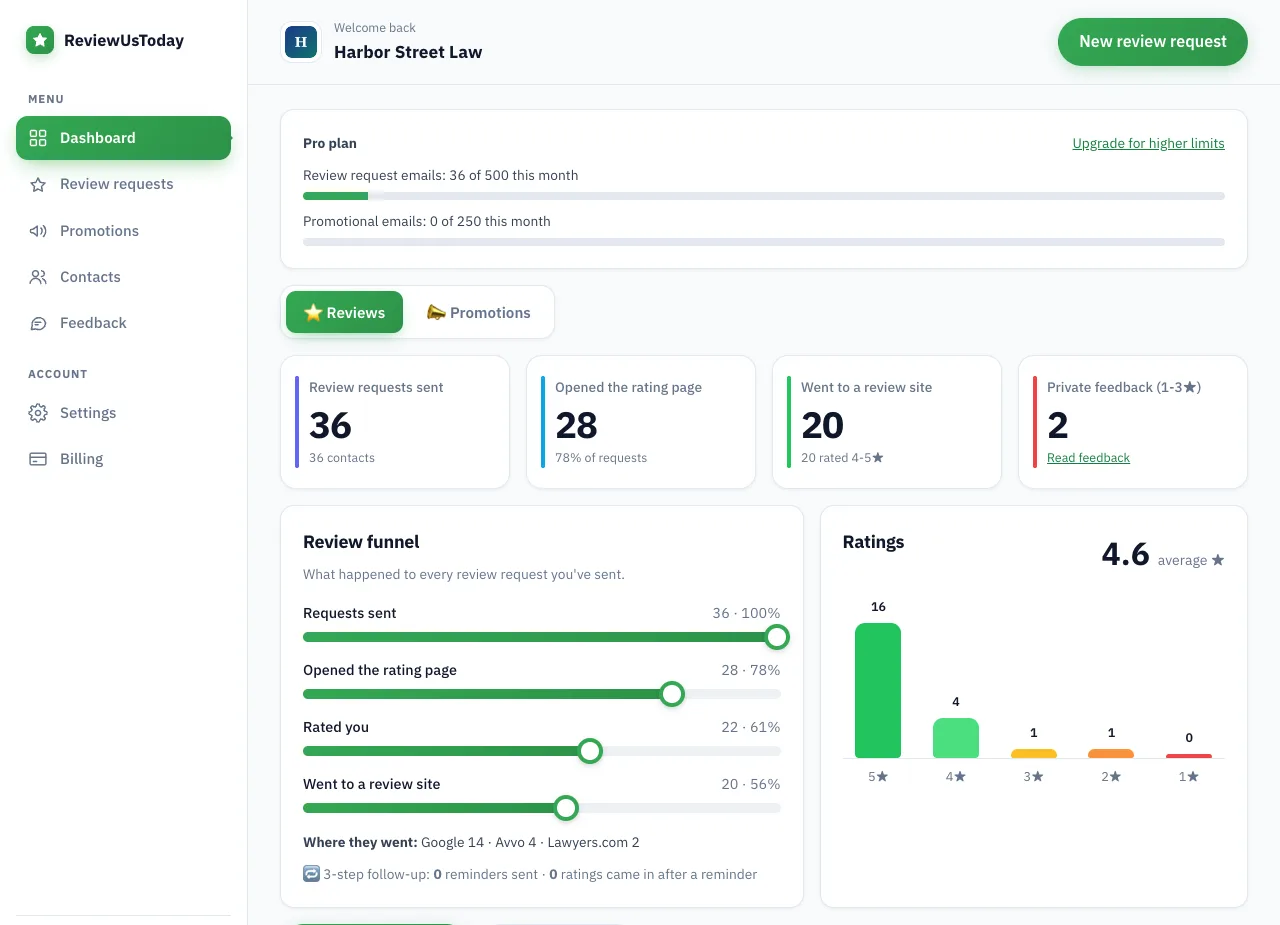
We ran a fictional firm, Harbor Street Law, through ReviewUsToday with 36 sample clients from "closed matters". It's a demo account with sample data, not a real firm's results, but it shows exactly what you'd see on day one.
| Step | Demo result |
|---|---|
| Review requests sent | 36 |
| Opened the rating page | 28 (78%) |
| Rated the firm | 22 |
| Went on to a review site | 20: Google 14, Avvo 4, Lawyers.com 2 |
| Sent private feedback instead | 2, both by email alert to the firm |
The two private notes were the useful kind: a slow call-back and a bill that needed explaining up front. Neither is a lawsuit. Both are fixable by Friday.
Where ReviewUsToday fits
ReviewUsToday handles the asking, in three steps:
- Upload a CSV of recently closed matters.
- Every client gets a one-tap rating email from your firm's name, and replies go to your inbox.
- Clients who rate 4 or 5 stars choose Google, Avvo, Lawyers.com or the sites you pick. Two automatic reminders go to anyone who hasn't responded.
It doesn't send texts, reply to reviews or monitor directories for you.
Plans start at $50 a month with no contract. See how review management works, or start with a free trial.
Frequently asked questions
Can a lawyer sue a client over a bad review?
Defamation law varies by state, so talk to counsel before acting. The FTC's 2024 rule prohibits businesses from using unfounded or groundless legal threats to prevent or remove a negative consumer review, and a public fight usually draws more attention to the review than it ever had.
Can a law firm offer a discount for leaving a review?
Some state bars have allowed small credits that don't depend on what the client writes, but Google's policy bans incentives for reviews of any kind. Since most clients read Google first, the safest choice is to offer nothing and ask everyone the same way.
Should a lawyer respond to every review?
Thank positive reviewers briefly and reply to negative ones with a short, general response that reveals nothing about the matter. If a reply would tempt you to discuss the case, a shorter reply is the better one.
When is the best time to ask a client for a review?
Right after the matter closes, while the result is fresh and the request can't look tied to how the case goes. Send a reminder a few days later, and a last one about a week after that.
Sources
- FindLaw: Key takeaways from the 2024 U.S. Consumer Legal Needs Survey
- FindLaw: The 2024 U.S. Consumer Legal Needs Survey: what attorneys need to know
- Texas Professional Ethics Committee: Opinion 685 (encouraging client reviews)
- Texas Professional Ethics Committee: Opinion 662 (responding to negative reviews)
- New York State Bar Association: Ethics Opinion 1052
- Google: Maps user-generated content policy (Rating manipulation)
- FTC: Final rule banning fake reviews and testimonials (August 2024)
- FTC: Consumer Reviews and Testimonials Rule, questions and answers
- Martindale-Hubbell: Ratings and reviews for consumers
- Yelp: Content guidelines
Keep reading
How to ask for a review: scripts, examples and timing
How to ask for a review without feeling awkward: word-for-word scripts for in person, email and receipts, when to ask by business type, and Google's rules.
How to respond to negative reviews
How to respond to negative reviews: a calm 5-step method, 8 templates for slow service, wrong orders, pricing, rude staff and fake reviews, and what to avoid.
Review gating: what it is, what Google and the FTC say, and what to do instead
Review gating means only sending happy customers to review sites. Here's what Google's policy and the FTC say, what is allowed, and a compliant review flow.