Real estate reputation management means earning a steady flow of honest client reviews on Google, Zillow and Realtor.com, then replying to them well. Ask every buyer and seller the same way right after closing, with a direct link. Never pay for reviews or ask only happy clients, and answer criticism calmly and briefly.
ReviewUsToday sends one-tap review requests for local businesses to 31 review sites, including Google, Zillow, Realtor.com and Facebook, with automatic reminders built in.
Which review sites matter most for real estate agents?
Google matters most for most agents, because it's where sellers search your name and your brokerage. Zillow and Realtor.com come next, since buyers browse agent profiles while they browse homes. Facebook helps if your referrals already live there. Yelp is a special case.
| Review site | Why it matters for an agent | Can you ask clients there? |
|---|---|---|
| Reviews show next to your name in search and on Maps | Yes, without incentives and without singling out happy clients (Google's policy) | |
| Zillow | Agent profiles with client reviews, seen by people already house hunting | Check Zillow's own help pages for its current review rules |
| Realtor.com | Agent profiles with ratings and reviews beside listings | Check Realtor.com's own help pages for its current rules |
| Recommendations on your page, seen by friends of past clients | Check Facebook's current rules | |
| Yelp | Some clients check it | No. Yelp's guidelines say "Businesses should never ask customers to write reviews." |
I'd pick two: Google plus whichever portal your market lives on. Give a happy seller five buttons and they'll freeze like it's a multiple-offer situation with no deadline. Our list of supported review sites shows the rest.
What is reputation management for real estate agents?
Reputation management for real estate agents is the work of shaping what a buyer or seller finds when they look you up. That means reviews, your star rating, your replies and your portal profiles. For a solo agent or small team, it mostly comes down to asking every client and replying well.
It matters because nearly everyone checks. In BrightLocal's Local Consumer Review Survey 2026:
| What consumers said | Share |
|---|---|
| Still lean on reviews to guide purchase decisions | 97% |
| "Always" read reviews when browsing for businesses | 41% (up from 29%) |
| Were asked to write a review in the last 12 months | 78% |
| Will "always" write one if asked | 28% (up from 16% in 2025) |
| Expect owners to respond to reviews | 89% |
The survey covers local businesses in general, not agents alone. Still, a seller choosing who'll sell their biggest asset isn't going to read less than someone choosing a pizza place. Referrals still matter too. A referred seller just Googles you before calling back, usually from the couch, usually at 10pm.
How do you ask for real estate reviews?
Ask every client right after closing, while the keys are still new in their hand. Send a short email with a direct link to your review page, then one or two reminders to anyone who hasn't responded. Ask buyers and sellers the same way, including the deals that got bumpy.
- Pick the moment. Closing day or the day after. Not mid-transaction, when a client could feel the request is tied to how the deal goes.
- Ask everyone. Same template for every buyer and seller, even after a tough inspection round.
- Send a direct link. A one-tap Google review link beats "find me on Google" every time.
- Remind twice, then stop. A nudge a few days later and a last one a week out.
- Offer nothing. No gift card, no closing-gift upgrade. Google's policy bars incentives "such as payment, discounts, free goods and/or services" for reviews.
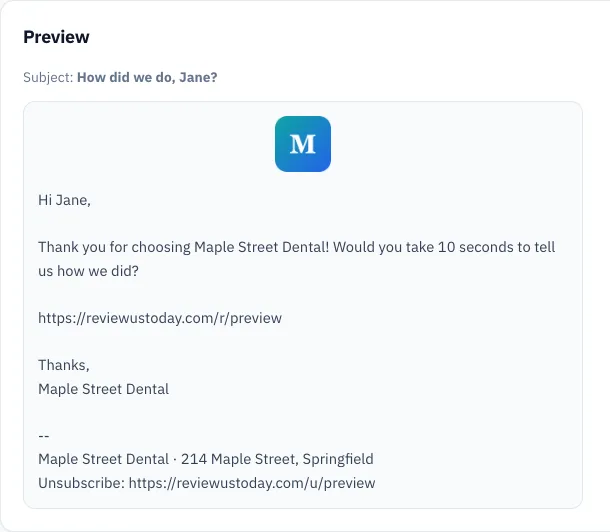
Here's a request you can steal:
"Hi Dana, congratulations again on the new place. If you have a minute, I'd love an honest review of how the move went. It helps the next family pick their agent. Here's the link: [your review link]. Thanks, Sam."
Our review request email templates have more versions, and the guide to asking for reviews covers the basics.
When should an agent send review requests and reminders?
Send the first request within a day of closing, a reminder about three days later, and a last one around day seven. After that, stop. Most clients who never review weren't unhappy; they were unpacking 40 boxes labeled "misc".
| When | What goes out | Who gets it |
|---|---|---|
| Day 0 (closing) | The review request | Every buyer and seller |
| Day 3 | A short reminder | Only clients who haven't rated |
| Day 7 | A last reminder | Only clients who still haven't rated |
If you'd rather not track that in a spreadsheet, ReviewUsToday's review management sends the request and both reminders for you. Reminders stop as soon as someone rates, and they only go out between 9am and 7pm in your time zone.
Is it review gating to ask only happy clients?
Yes. Asking only the clients you expect to be happy is review gating. Google's policy says businesses may not "selectively solicit positive reviews from customers." Screening clients with a survey first, then sending only the satisfied ones to Google, counts too.
The FTC's 2024 rule on fake reviews also bans certain incentives. It covers incentives "conditioned on the writing of consumer reviews" "expressing a particular sentiment, either positive or negative." Here's how the usual situations line up:
| What you do | Allowed? |
|---|---|
| Ask every client for an honest review | Yes. Google lets businesses encourage genuine reviews without incentives |
| Ask only the clients who sent a thank-you card | No: that's selective soliciting |
| Offer a gift card for a review | No: Google bars incentives |
| Offer a gift card only for a 5-star review | No: the FTC rule bans sentiment-based incentives |
A compliant flow can still let you hear about problems first. Our guide to review gating explains how, without blocking anyone from posting publicly.
How should a real estate agent respond to a negative review?
Reply briefly, politely and without private details. Thank the client, acknowledge the issue, and invite them to call you. Google's Business Profile help says to keep replies short and never share a reviewer's private information. If the issue is complex, ask them to contact you privately.
| In a public reply, do | In a public reply, don't |
|---|---|
| Use the reviewer's name and thank them | Mention the sale price, offers, lender issues or anything private |
| Apologize where something did go wrong | Take blame for things outside your control, like the appraisal |
| Invite them to call you directly | Argue point by point, or blame the other agent |
Something like this works:
"Thanks for the feedback, Chris. I'm sorry the closing timeline felt rushed. I'd like to hear more, so please call me directly at the office."
Future sellers read your reply more closely than the review. They're checking whether you'd stay calm when their own deal hits a snag. More examples are in our guide to responding to negative reviews.
What happens when a client taps a low rating?
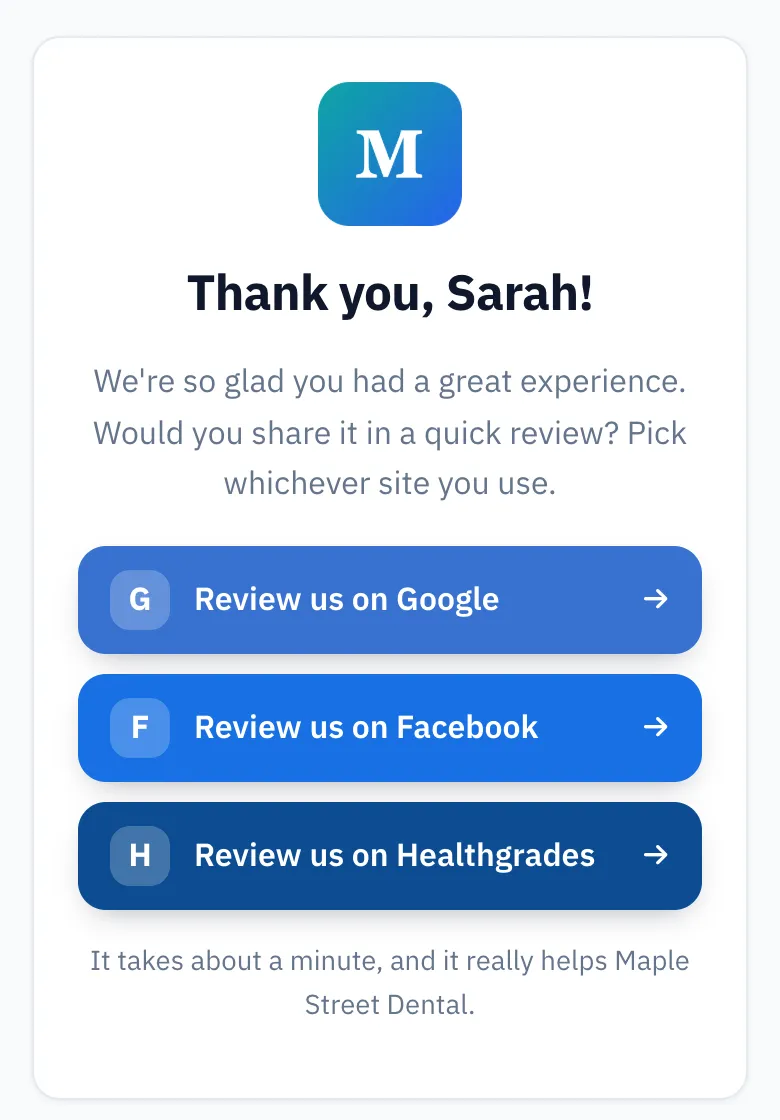
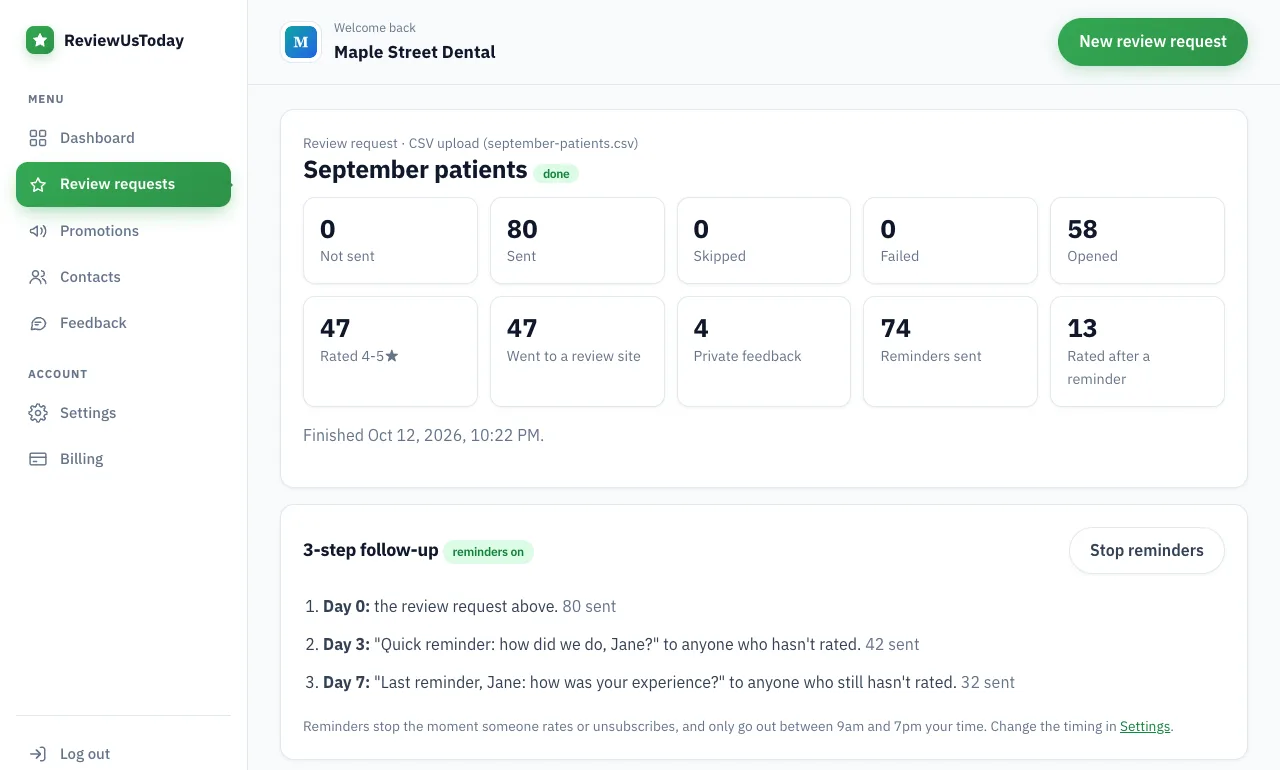
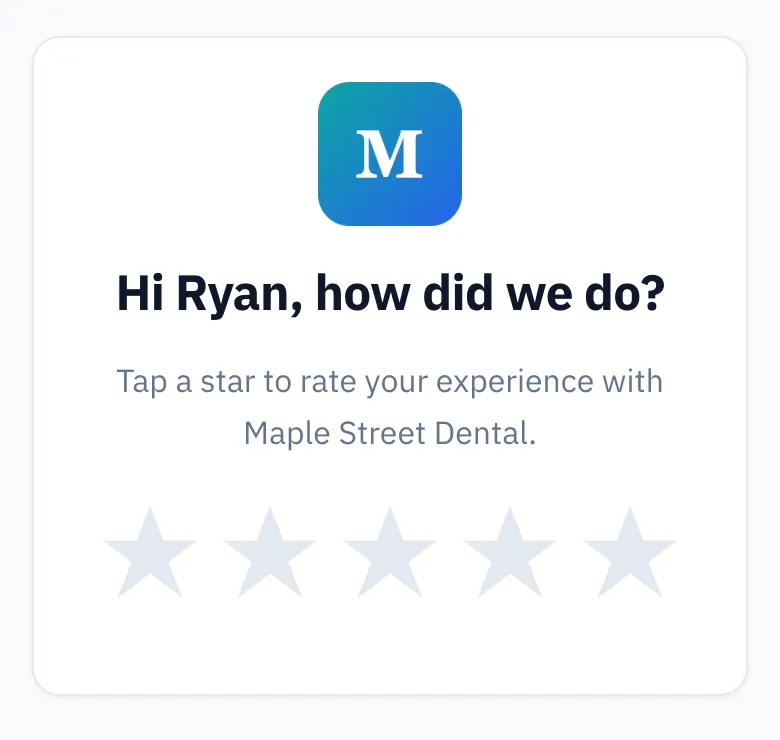
In ReviewUsToday, a client who taps 1 to 3 stars sees a short private form. It asks: "What could we have done better?" Their answer emails you an instant alert. The same page still shows a button for every public review site you picked, so nobody is blocked from posting.
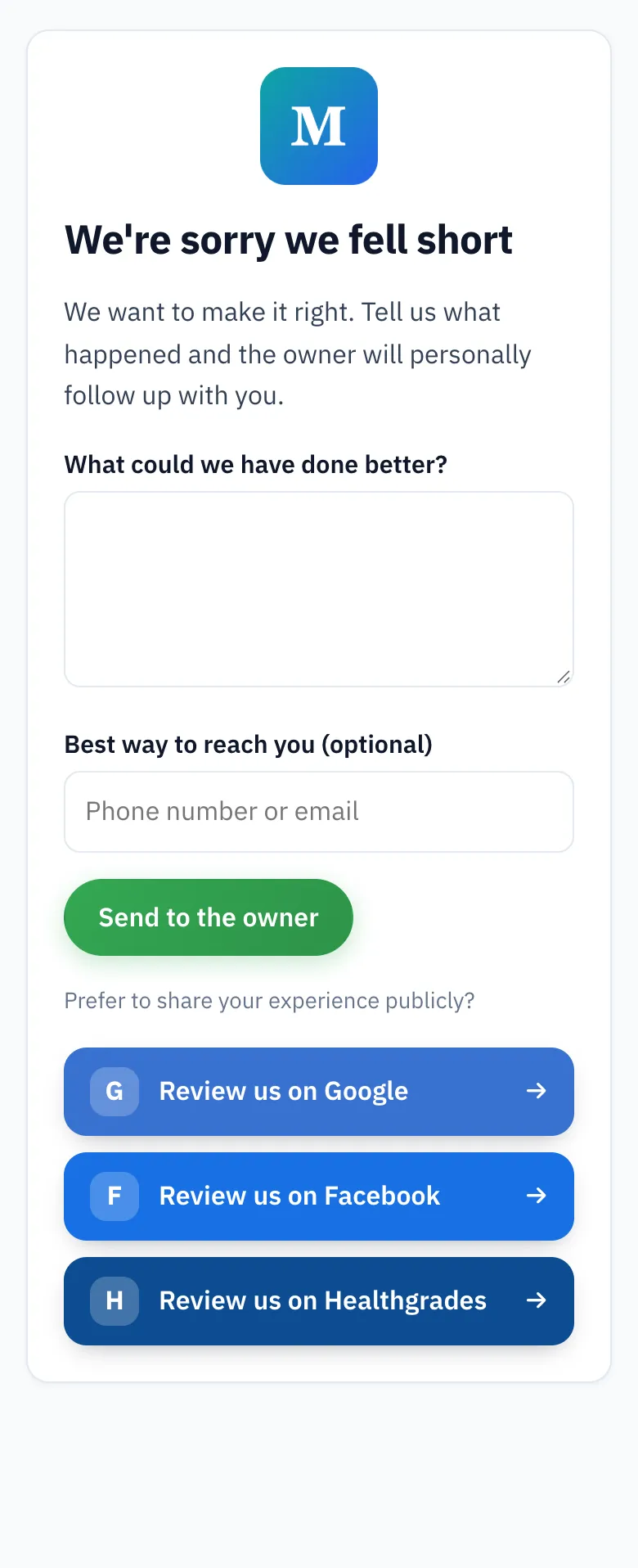
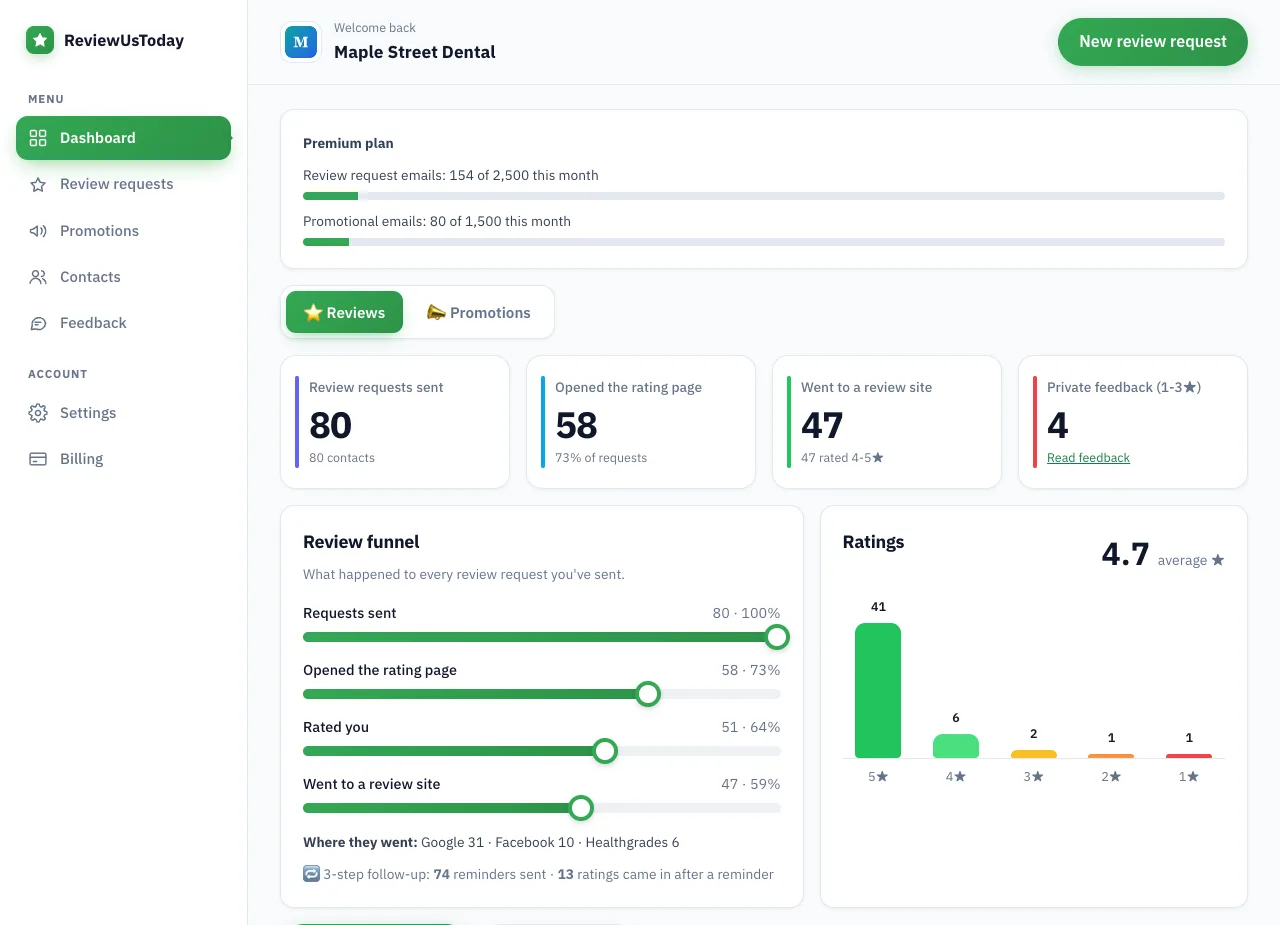
A client who taps 4 or 5 stars goes straight to your review site, or picks from your buttons if you set up a few. Here's what the dashboard showed in our demo account, a fictional dental office, Maple Street Dental, run with 80 sample customers. It's sample data, not a real business's results, but the funnel is the same for an agent.
| Step (demo, sample data) | Result |
|---|---|
| Requests sent | 80 |
| Opened the rating page | 58 |
| Rated | 51 |
| Went to a review site | 47 |
| Ratings that came in after a reminder | 13 |
I'd watch that last row closely. It's the part most agents skip when they ask by hand, and it's a nice reminder that "forgot" isn't the same as "no".
Where ReviewUsToday fits
ReviewUsToday emails every client a one-tap rating request from your name after closing, then sends up to two reminders. Clients who rate 4 or 5 stars go to Google, Zillow, Realtor.com or the sites you choose. It doesn't send texts, reply to reviews or monitor your portal profiles. See how the review request software works, with plans from $50 a month and no contract.
Frequently asked questions
How do I get more reviews as a real estate agent?
Ask every buyer and seller right after closing, with a direct link to your review page. Send a reminder a few days later and a last one about a week after that, then stop.
Can real estate agents offer a gift for a review?
Not for Google reviews. Google's policy bars incentives such as payment, discounts, free goods or services in exchange for a review, and the FTC bans incentives tied to a positive or negative review.
Should real estate agents use Yelp for reviews?
You can claim your Yelp page, but don't ask clients for Yelp reviews. Yelp's guidelines say businesses should never ask customers to write reviews.
Should an agent reply to every review?
Reply to every negative review and to positive ones where you have something useful to add. Keep replies short, personal and free of private deal details.
When is the best time to ask for a real estate review?
Closing day or the day after, while the move is fresh. Asking mid-transaction can make the request feel tied to how the deal goes.
Sources
Keep reading
How to ask for a review: scripts, examples and timing
How to ask for a review without feeling awkward: word-for-word scripts for in person, email and receipts, when to ask by business type, and Google's rules.
Review request template: 7 emails you can copy and send today
Copy-paste review request template emails with subject lines: after a service, after a purchase, reminders, a short version, an owner note and a clinic version.
How to respond to negative reviews
How to respond to negative reviews: a calm 5-step method, 8 templates for slow service, wrong orders, pricing, rude staff and fake reviews, and what to avoid.