The core NPS survey question is "How likely are you to recommend us to a friend or colleague?", answered on a 0 to 10 scale. People who answer 9 or 10 are promoters, 7 or 8 are passives, and 0 to 6 are detractors. Add one open follow-up question asking why, and keep the whole survey short.
ReviewUsToday sends one-tap 1-5 star rating requests for local businesses, with a private feedback form for low ratings and an instant alert to the owner. It's built around one short question, asked the same way of every customer.
What is the NPS survey question?
NPS stands for Net Promoter Score. According to Bain's Net Promoter System site, you ask one question: "How likely are you to recommend us to a friend or colleague?" Customers answer on "a simple zero-to-ten scale," and each answer puts them in one of three groups.
| Score | Group (Bain's terms) | What it usually means for you |
|---|---|---|
| 9 to 10 | Promoters | Likely to recommend you. Good people to ask for a public review. |
| 7 or 8 | Passives | Happy enough, not raving. Not counted in the score. |
| 0 to 6 | Detractors | Something went wrong, or nothing went especially right. |
That's the whole official question. Everything else in this post is a follow-up, a wording variation, or advice on when to send it. If you're still choosing between NPS and other survey types, our customer feedback survey guide compares them side by side. It's a refreshingly short definition for something with its own acronym, three customer categories and, in some companies, a quarterly meeting.
How do you calculate an NPS score?
Bain's site spells out the math. Your Net Promoter Score "is simply the percentage of customers who are promoters (those who scored 9 or 10)" "minus the percentage who are detractors (those who scored 0 to 6)." Passives count toward the total number of replies but don't add or subtract anything.
Here's a worked example with 100 made-up replies.
| Group | Replies | Share |
|---|---|---|
| Promoters (9 to 10) | 60 | 60% |
| Passives (7 to 8) | 25 | 25% |
| Detractors (0 to 6) | 15 | 15% |
| NPS | 60 minus 15 = 45 |
Because it's one percentage minus another, the score can land anywhere from -100 (every reply a detractor) to 100 (every reply a promoter). It's written as a plain number, not a percentage. Writing "45%" is the fastest way to start an argument in a meeting full of analysts.
One thing I'd keep in mind as a small business: with 20 replies, a single customer moves your score by 5 points. Don't redesign the waiting room because one Tuesday was rough. Watch the trend over a few months, and read the comments every week. The comments tell you what to fix, and the number tells you whether it worked.
What are the best NPS follow-up questions?
The best NPS follow-up question is a simple open one: "What's the main reason for your score?" It turns a number into something you can fix. Then, if you want, add one more question tailored to the customer's group. Promoters, passives and detractors each get a question that fits.
| # | Follow-up question | Best for |
|---|---|---|
| 1 | What's the main reason for your score? | Everyone |
| 2 | What's one thing we could do better? | Everyone |
| 3 | What did you like most about your visit? | Promoters |
| 4 | Would you mind sharing that in a public review? | Promoters (but see the review gating section) |
| 5 | Who on our team made the biggest difference? | Promoters |
| 6 | What would have made this a 10? | Passives |
| 7 | Was anything missing from your visit? | Passives |
| 8 | What almost stopped you from booking with us? | Passives |
| 9 | What went wrong? | Detractors |
| 10 | What could we have done better? | Detractors |
| 11 | Can we contact you to put it right? | Detractors |
| 12 | Is there anything else you'd like the owner to know? | Everyone, as a last optional box |
Pick one or two follow-ups, not all twelve. A survey that starts with one easy tap and ends with an essay prompt is how people learn to ignore your emails.
NPS question examples for local businesses
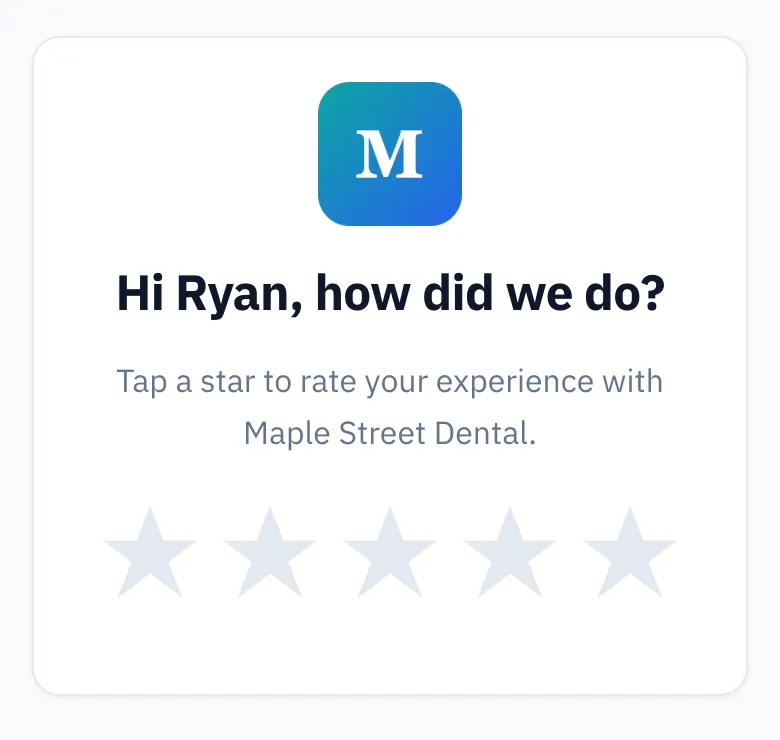
For a local business, adapt the core question so it names your business and fits how people recommend you. "Friend or colleague" sounds odd for a dentist or a plumber, so many businesses swap in "friend or neighbor" or "friend or family member." Keep the 0 to 10 scale exactly as it is.
| # | Business | NPS question |
|---|---|---|
| 13 | Dental office | How likely are you to recommend Bright Smile Dental to a friend or family member? |
| 14 | Plumber or HVAC | How likely are you to recommend us to a neighbor who needs a plumber? |
| 15 | Restaurant | How likely are you to recommend us to a friend looking for dinner? |
| 16 | Salon or spa | How likely are you to recommend your stylist to a friend? |
| 17 | Auto repair | How likely are you to recommend our shop to a friend with car trouble? |
| 18 | Real estate agent | How likely are you to recommend me to someone buying or selling a home? |
| 19 | Gym or studio | How likely are you to recommend our classes to a friend? |
| 20 | Vet clinic | How likely are you to recommend us to another pet owner? |
I'd change only the "who" and the business name. Reword the core of the question and your score stops being comparable with last year's. Then you'll spend a weekend wondering whether customers got happier or you just asked nicer.
What is the difference between relational and transactional NPS?
Relational NPS asks about your business overall, usually on a regular schedule like once or twice a year. Transactional NPS asks about one specific visit or job, right after it happens. Most local businesses get more use from transactional questions, because the visit is fresh and the answer points at something specific.
| # | Type | Sample question | When to send |
|---|---|---|---|
| 21 | Relational | Based on everything so far, how likely are you to recommend us to a friend? | Once or twice a year |
| 22 | Relational | How likely are you to recommend us, compared with others you've used? | Once a year |
| 23 | Transactional | Based on today's visit, how likely are you to recommend us to a friend? | Same day or next day |
| 24 | Transactional | Based on this repair, how likely are you to recommend us to a neighbor? | A day after the job |
| 25 | Transactional | How likely are you to recommend our online booking to a friend? | Right after booking |
If I ran a busy cafe, I'd skip relational surveys entirely. A regular who comes in every morning will tell you what they think by 8:05am, unprompted, while you're still finding the oat milk.
How many questions should an NPS survey have, and when should you send it?
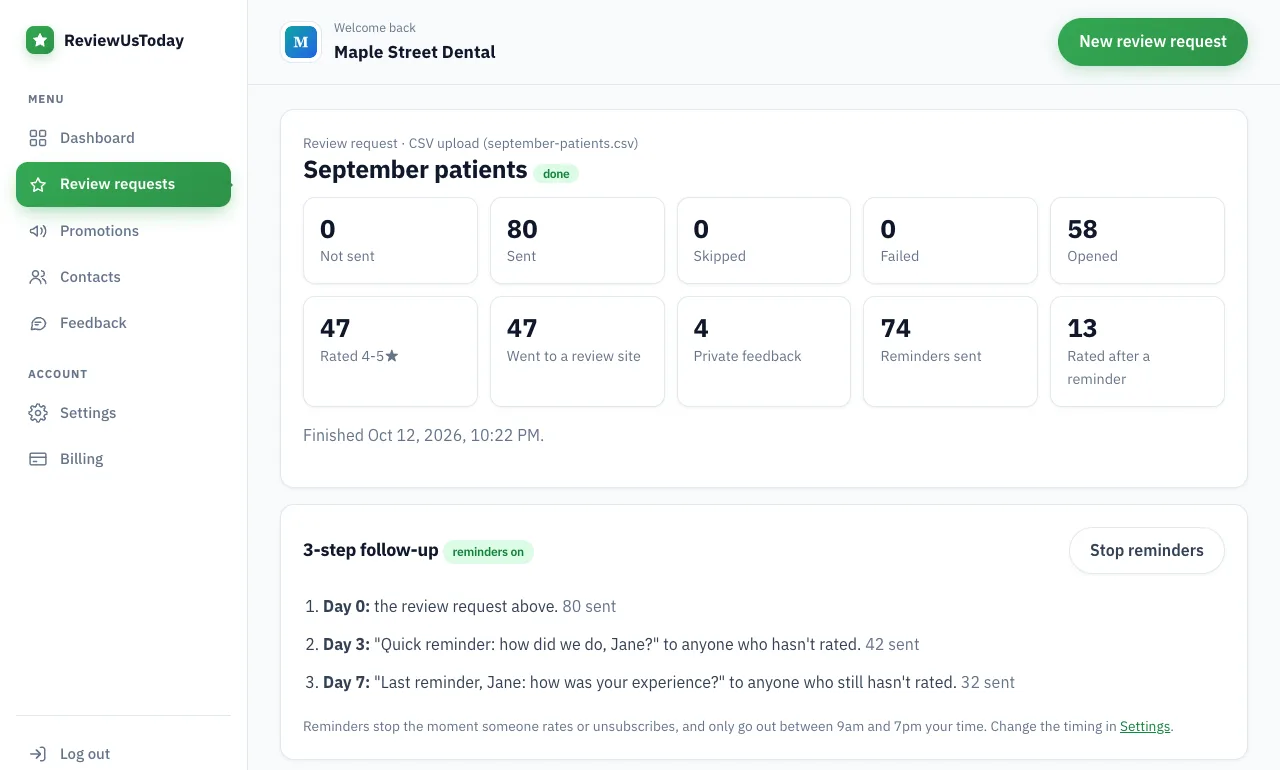
Keep an NPS survey to two questions: the 0 to 10 rating and one open follow-up. Send it within a day of the visit, by email, with the rating in the email itself or one tap away. A single reminder a few days later picks up people who meant to answer and didn't.
Five more questions worth having in your back pocket, if you truly need extra detail:
- How easy was it to book with us?
- How would you rate the value for what you paid?
- Did we finish the job when we said we would?
- How did you first hear about us?
- Would you like us to follow up about your answer?
Each extra question costs you replies. I'd add one only when you'll actually act on the answer, not because the survey tool had a spare slot. "Nice to know" questions are the junk drawer of surveys.
| When | What to send |
|---|---|
| Day 0 or Day 1 | The rating question plus one follow-up |
| Day 3 | One short reminder to anyone who hasn't answered |
| Within a week | A personal reply to every detractor |
That last row matters. BrightLocal's Local Consumer Review Survey 2026 found 81% of consumers expect a response to a review within a week. A private survey answer deserves at least the same speed.
A reply to a detractor works best when it's short and specific. Thank them, name the problem they raised, and say what you'll change.
Our guide on how to respond to negative reviews has wording that works just as well in a private email.
Prefer not to send reminders by hand? ReviewUsToday's review management sends a one-tap star rating with two automatic reminders. It's the same rhythm, with stars instead of a 0 to 10 scale.
Can you send NPS promoters to Google for reviews?
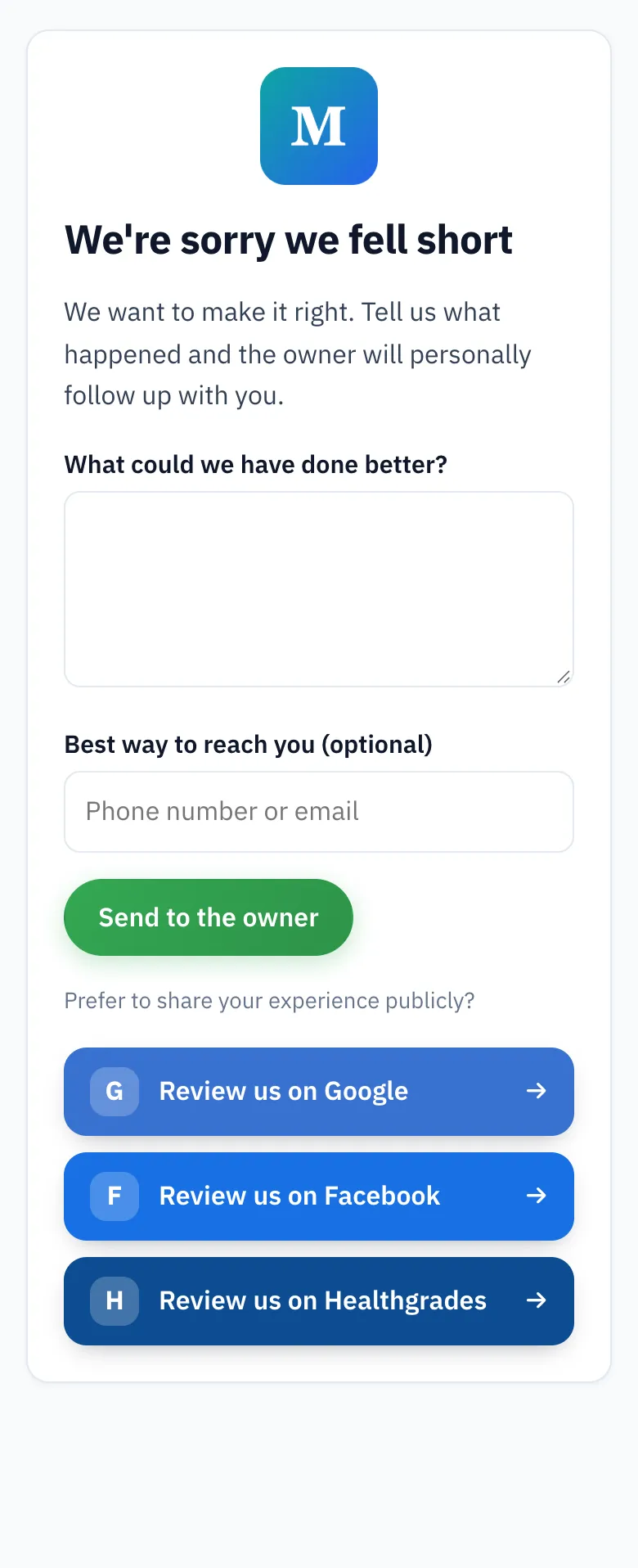
Not only promoters. Sending just your 9s and 10s to Google, while detractors never see the option, is review gating. Google's Maps user-generated content policy says businesses may not "selectively solicit positive reviews from customers."
That's where follow-up question 4 gets tricky. It's fine to invite promoters to post a review. It's a problem when that invitation is the only path to Google, and only promoters get it. The fix is simple: offer every customer the public review link, whatever they scored.
| Survey flow | Review gating? |
|---|---|
| Everyone gets the survey, only 9-10 scorers see a Google link | Yes |
| Everyone gets the survey, everyone sees a Google link | No |
| Low scorers get a private form and the Google link | No |
Our guide to review gating covers the rule in more detail. It's one of those policies that sounds like legal fine print until it removes reviews you were proud of.
Should a local business use NPS or a star rating?
For most local businesses, a 1-5 star rating is the simpler choice. Customers already understand stars from Google, so they answer faster. NPS is better for tracking loyalty over time across lots of replies, especially when you'll compare scores month to month or between locations.
| NPS (0 to 10) | Star rating (1 to 5) | |
|---|---|---|
| Question | How likely are you to recommend us? | How did we do? |
| Familiar to customers | Somewhat | Very, from Google and other review sites |
| Best for | Tracking loyalty over time | Quick feedback after each visit, tied to reviews |
| Small samples | Swings a lot | Average is easier to read |
To be clear about our own product: ReviewUsToday uses a 1-5 star rating, not NPS. It doesn't calculate a Net Promoter Score or build multi-question surveys. If NPS tracking is the goal, a dedicated survey tool fits better. If you want a quick rating that also feeds your reviews, stars do that job.
What one-tap rating requests look like in a demo account
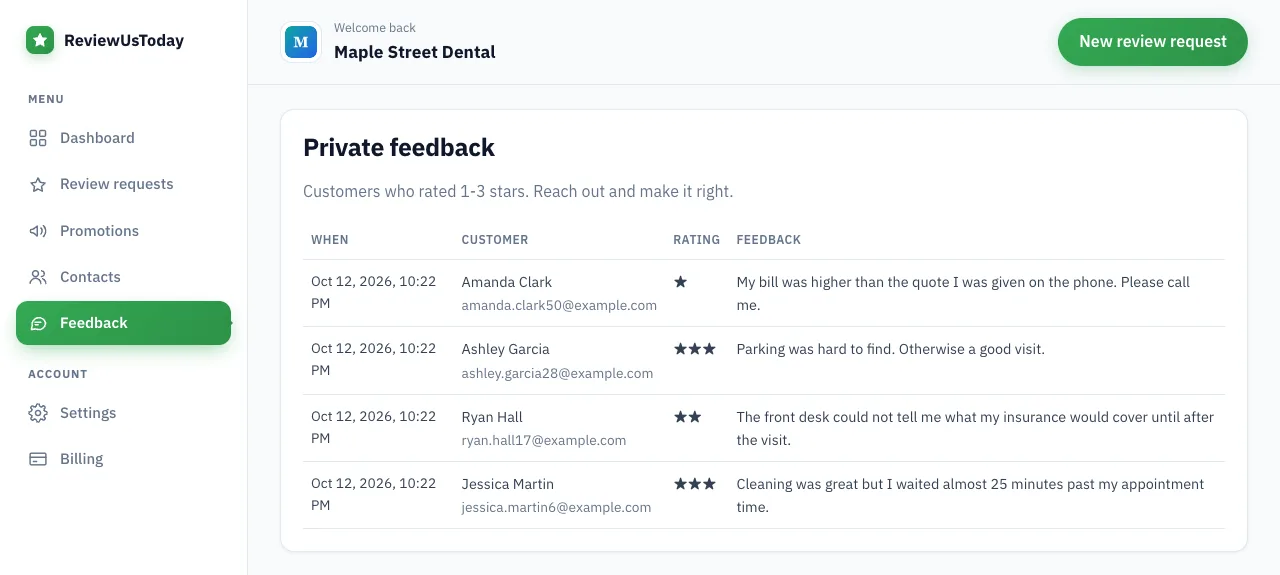
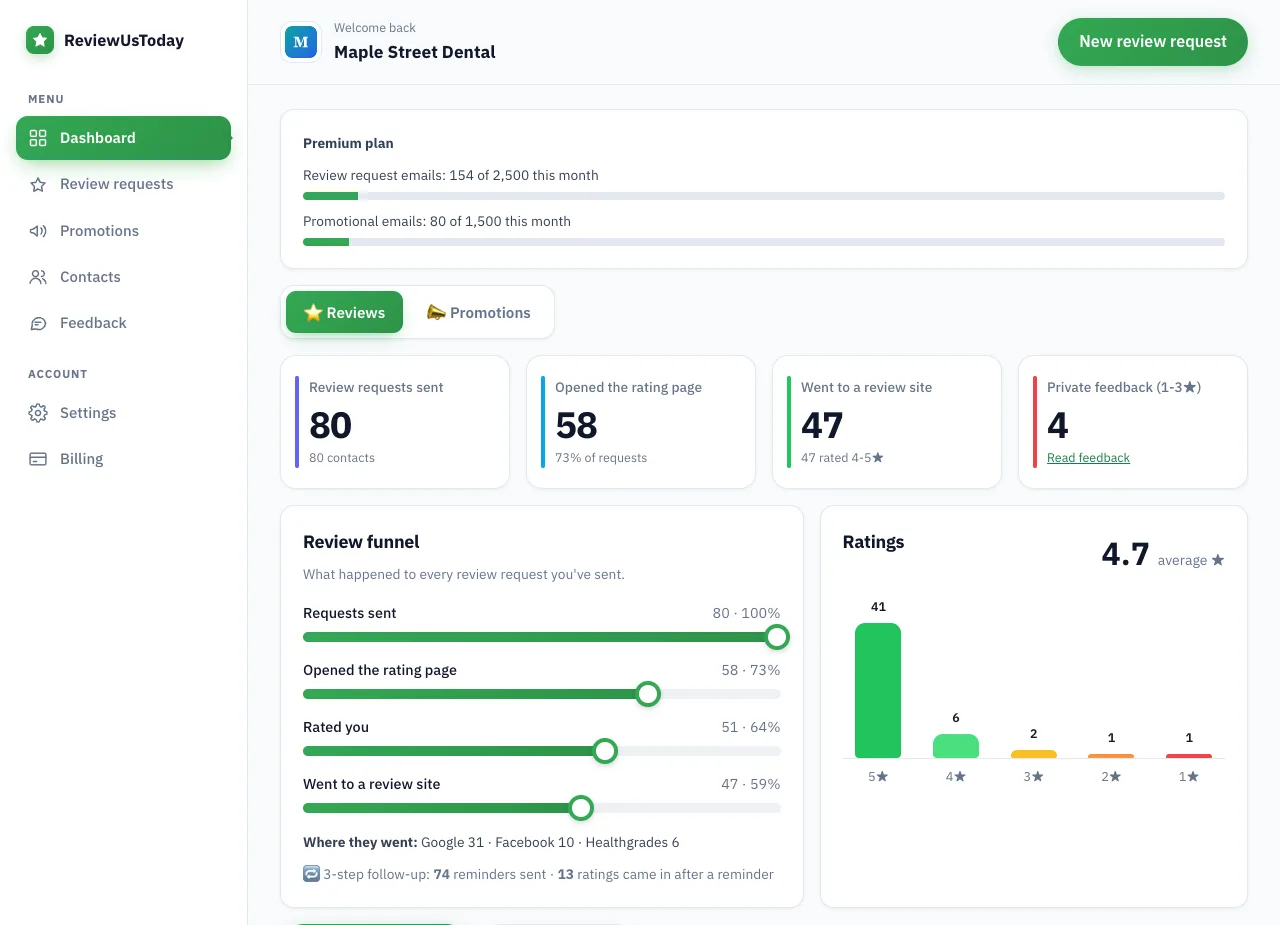
We ran a fictional dental office, Maple Street Dental, through ReviewUsToday with 80 sample customers. It's a demo account with sample data, not a real business's results. The funnel shows what a short, star-based question gets you.
| Step (demo, sample data) | Result |
|---|---|
| Rating requests sent | 80 |
| Opened the rating page | 58 |
| Rated | 51, average 4.7 stars |
| Rated 4-5 and went to a review site | 47 |
| Left private feedback | 4 |
| Ratings that came in after a reminder | 13 |
You can't turn those stars into an NPS score, and I wouldn't try. Stars and the 0 to 10 scale measure different questions. What the demo does show is the shape: a one-tap question gets answered, and reminders bring in people who meant to reply.
Where ReviewUsToday fits
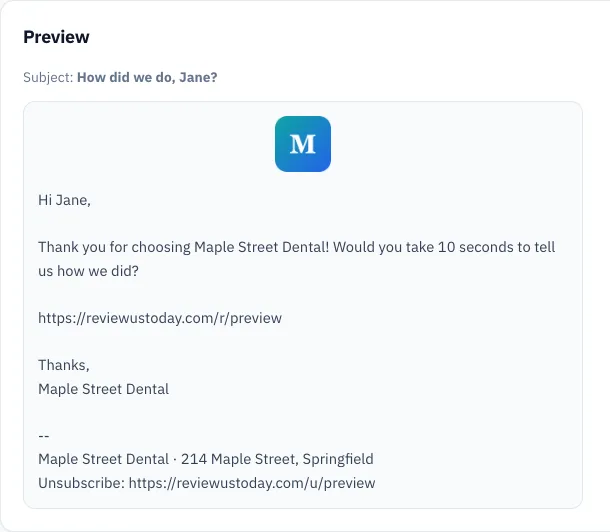
ReviewUsToday isn't an NPS tool. It emails every customer a one-tap 1-5 star rating request. Low ratings get a private feedback form with an instant alert, and every customer still sees your public review buttons. If that's the feedback loop you want, see how review management works.
Frequently asked questions
What is the standard NPS question?
The standard question is "How likely are you to recommend us to a friend or colleague?" on a 0 to 10 scale. Many businesses swap "friend or colleague" for wording that fits their customers, like "friend or neighbor."
How do you calculate NPS?
Subtract the percentage of detractors (scores of 0 to 6) from the percentage of promoters (scores of 9 or 10). Passives (7 or 8) count in the total but are neither added nor subtracted.
How many questions should an NPS survey have?
Two is enough for most local businesses: the 0 to 10 rating and one open question asking for the reason. Each extra question tends to cost you replies.
What is a good follow-up question for NPS?
"What's the main reason for your score?" works for everyone. For detractors, "What could we have done better?" gives you something specific to fix.
Is NPS better than a star rating?
Not for every business. NPS is good for tracking loyalty over time across many replies, while a 1-5 star rating is quicker to answer and more familiar from review sites.
Sources
Keep reading
Customer feedback survey: what to ask, when to send it, and how to keep it honest
Customer feedback survey guide for local businesses: questions by business type, how short to keep it, when to send it, and how to avoid review gating.
Review gating: what it is, what Google and the FTC say, and what to do instead
Review gating means only sending happy customers to review sites. Here's what Google's policy and the FTC say, what is allowed, and a compliant review flow.
How to respond to negative reviews
How to respond to negative reviews: a calm 5-step method, 8 templates for slow service, wrong orders, pricing, rude staff and fake reviews, and what to avoid.